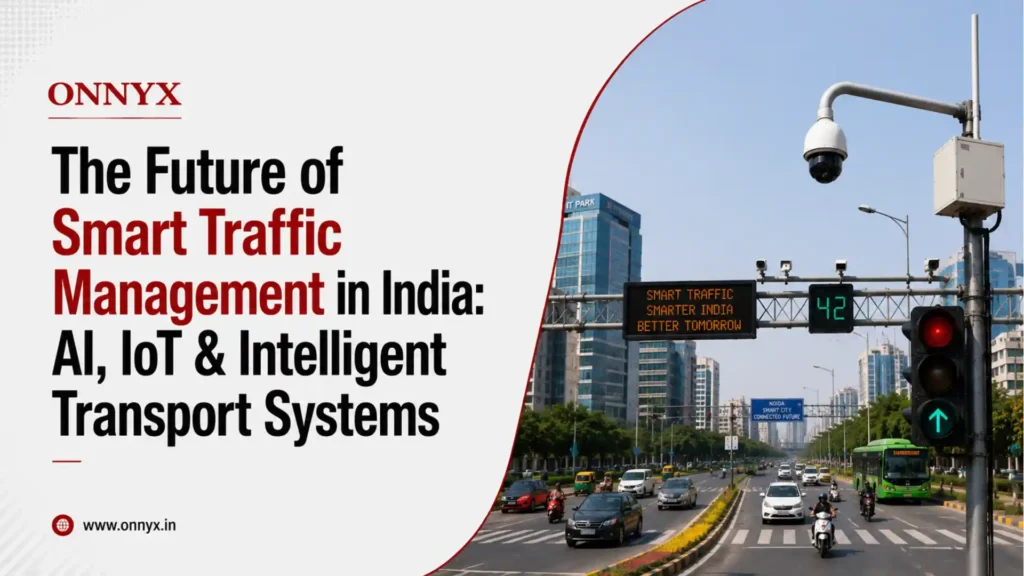
The Future of Smart Traffic Management in India: AI, IoT & Intelligent Transport Systems
The Future of Smart Traffic Management in India: AI, IoT & Intelligent Transport Systems India’s urban centers face escalating traffic congestion, a challenge exacerbated by rapid urbanization and vehicle growth. With retail vehicle registrations reaching a record high of nearly 3 crore units in FY26, a 13% year-on-year increase, cities desperately need advanced solutions to manage mobility and enhance public safety. Government initiatives, particularly the Smart Cities Mission, have laid foundational infrastructure, driving the adoption of Intelligent Transport Systems (ITS) that transition traffic management from reactive to predictive systems. This article introduces a three-layer transformation framework for understanding smart traffic management: Layer 1 focuses on AI-Powered Adaptive Control for real-time optimization, Layer 2 on IoT-Enabled Connected Infrastructure for a robust data ecosystem, and Layer 3 on Intelligent Transport Systems for holistic mobility management. This framework provides urban authorities with a clear mental model for phased implementations, understanding technology interdependencies, and communicating requirements to stakeholders effectively. The Current State of Traffic Management Infrastructure in India Traditional traffic control systems in India often rely on fixed-timing signals, manual enforcement, and limited data visibility, leading to inefficiencies and increased congestion. While the Smart Cities Mission, which formally closed in March 2025, has driven significant infrastructure investments, the operational maturity of these systems varies across cities. All 100 Smart Cities now have operational Integrated Command and Control Centres (ICCCs), with 30 actively engaged in traffic management and transportation functions. Despite these advancements, a significant gap remains when compared to global smart traffic benchmarks, particularly in pervasive real-time data integration and predictive analytics. The cost of inaction is substantial, with congestion contributing to economic losses, increased fuel consumption, and compromised road safety. For instance, Delhi’s vehicle population increased by 7.9% year-on-year to 8.76 million by March 2026, indicating persistent urban congestion pressure. Layer 1: AI-Powered Adaptive Traffic Control Systems AI-powered adaptive traffic control systems leverage machine learning algorithms to dynamically optimize signal timing based on real-time traffic density and predictive patterns. These systems utilize computer vision and video analytics for automated vehicle detection, classification, and flow measurement, moving beyond static, pre-programmed signal cycles. Onnyx Electronisys specializes in deploying such advanced solutions, enabling cities to enhance operational efficiency and public safety. Pilot implementations in Indian cities demonstrate significant improvements: Bengaluru’s Adaptive Traffic Control System (B-ATCS) reported a 33% reduction in waiting time and an 18% increase in vehicle throughput at Hudson Circle. Pune’s AI-enabled ICCC, covering 101 synchronized locations, achieved a 21% drop in congestion at major junctions and a 10.4% rise in traffic speeds. Agartala saw a 30% improvement in average vehicle throughput during peak hours after deploying AI-based adaptive signals across 22 junctions. These systems also integrate with emergency vehicle priority systems and public transport corridors, ensuring smoother passage for critical services and promoting efficient urban mobility. Capability/Feature Traditional Fixed-Timing Systems AI-Powered Adaptive Systems Impact on Traffic Flow Signal Timing Adjustment Pre-set, static schedules; adjusted manually for major changes. Real-time dynamic adjustment based on vehicle presence and flow. Reduces unnecessary stops and delays, optimizes green time. Incident Detection Speed Manual observation or citizen reports; slow response. Automated detection via video analytics; near-instant alerts. Faster incident clearance, prevents secondary congestion. Traffic Data Collection Limited, periodic manual counts or basic loop detectors. Continuous, high-resolution data from cameras and various sensors. Provides comprehensive insights for urban planning and optimization. Multi-Corridor Coordination Difficult to synchronize across multiple intersections. Network-wide optimization, coordinating adjacent signals for smooth flow. Minimizes ripple effect of congestion, improves journey times. Emergency Vehicle Priority Manual override or no dedicated system. Automated green light sequencing for approaching emergency vehicles. Reduces response times, enhances public safety. System Maintenance Requirements Primarily hardware checks and physical repairs. Software updates, algorithm tuning, sensor calibration, and hardware maintenance. Proactive issue identification, enhanced system longevity. Layer 2: IoT-Enabled Connected Infrastructure Ecosystem The second layer of smart traffic management involves an IoT-enabled connected infrastructure that creates real-time traffic data streams across city networks. This ecosystem relies on sensor networks, RFID, and other connected devices. These components aggregate data from diverse sources including GPS, mobile networks, and traffic cameras. Key elements of this layer include: Vehicle-to-Infrastructure (V2I) Communication: While V2V communication mandates for new vehicles are phased for 2027-2028, V2I will lag, requiring roadside infrastructure development to enable coordinated traffic management. Smart Parking Systems: Real-time occupancy data guides drivers to available spots, reducing cruising for parking. Electronic Toll Collection: FASTag has already demonstrated the efficiency of automated tolling, reducing queue times and fuel waste. Onnyx Electronisys leverages these IoT capabilities to build robust, data-driven platforms for urban traffic control. The strategic choice of low-power wide-area networks (LPWAN) like LoRaWAN can offer significant cost advantages for distributed urban sensing, being approximately three times cheaper than 4G-based alternatives at scale. Layer 3: Intelligent Transport Systems (ITS) for Holistic Urban Mobility Intelligent Transport Systems (ITS) represent the culmination of AI and IoT integration, providing a holistic approach to urban mobility. These systems are typically managed from Centralized Traffic Management Centers (TMC) with Integrated Command & Control Center (ICCC) capabilities. FHWA describes a TMC as the “hub or nerve center” of a TMS, coordinating data collection, command and control of ITS devices, incident response, and traveler information dissemination in a briefing. ITS encompasses several critical functions: Predictive Analytics: Forecasting traffic patterns and proactively managing congestion through route optimization. Automated Enforcement Systems: These include red light violation detection, speed monitoring, and number plate recognition. Kerala’s AI-enabled system detected 11.04 lakh violations in 16 days, with 99% accuracy for speed and red-light violations. Public Information Systems: Real-time traveler information delivered via mobile apps and dynamic message signs empowers commuters. Onnyx Electronisys develops and integrates these advanced ITS components, providing cities with comprehensive tools for managing their transportation networks. These systems move beyond reactive responses to provide proactive and predictive insights for urban mobility. Implementation Roadmap: From Pilot to City-Wide Deployment Implementing smart traffic management systems in Indian cities requires a structured, phase-wise approach. This begins with a thorough assessment of existing infrastructure and traffic patterns. Onnyx Electronisys recommends the
The Future of Smart Traffic Management in India: AI, IoT & Intelligent Transport Systems Read More »