
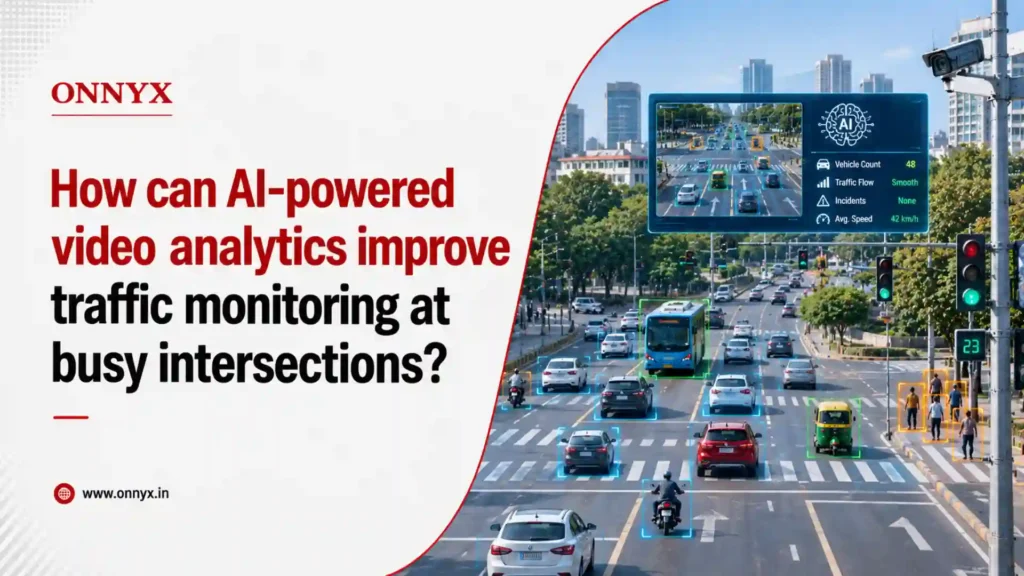
How can AI-powered video analytics improve traffic monitoring at busy intersections?
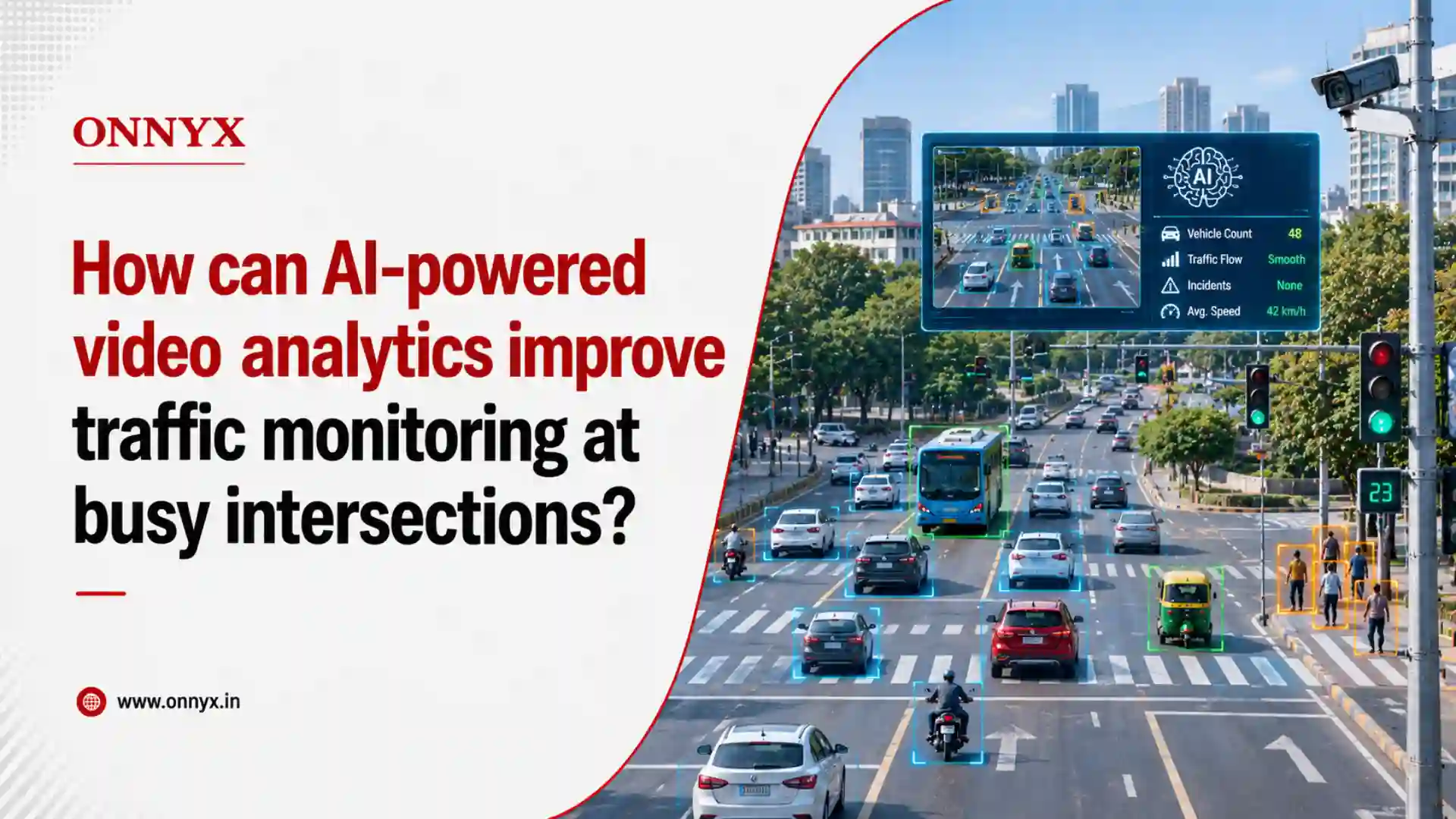
Urban intersections present complex monitoring challenges, handling thousands of vehicles daily and often becoming bottlenecks for urban mobility. Traditional manual monitoring and basic camera systems lack the real-time analytical capabilities needed to effectively manage these dynamic environments.
AI-powered video analytics transforms raw video footage into actionable traffic intelligence, directly addressing issues of congestion, safety, and operational efficiency for smart city authorities and transportation agencies.
What AI-Powered Video Analytics Means for Traffic Monitoring
AI-powered video analytics refers to computer vision systems that analyze live or recorded video feeds to automatically detect, classify, and track vehicles, pedestrians, and traffic patterns at intersections. This technology goes beyond standard CCTV by adding an intelligent analytics layer that converts visual data into structured, actionable insights.
Onnyx Electronisys integrates these advanced capabilities with existing traffic management infrastructure to provide comprehensive Intelligent Transportation Systems (ITS). These systems deliver core functions such as vehicle counting, classification, speed detection, violation identification, and incident detection, which are critical for modern urban mobility.
The 4-Layer Intelligence Framework: Transforming Intersections
Onnyx Electronisys utilizes a proprietary 4-Layer Intelligence Framework to maximize the value of AI video analytics at intersections. Each layer builds upon the previous one, transforming intersections from passive observation points into proactive, intelligent traffic nodes.
- Detection Layer: This foundational layer identifies all objects of interest within the camera’s field of view, such as vehicles, pedestrians, and cyclists. It establishes the presence of traffic elements.
- Classification Layer: Building on detection, this layer categorizes identified objects into specific types (e.g., cars, buses, two-wheelers, heavy vehicles, pedestrians). This allows for granular traffic composition analysis.
- Behavioral Layer: This layer analyzes the movement patterns and actions of classified objects to identify standard and anomalous behaviors, including speed, direction, queue formation, and traffic violations.
- Predictive Layer: The most advanced layer uses data from the preceding layers, combined with historical trends, to forecast potential congestion, predict incident likelihood, and recommend proactive interventions.
This layered approach ensures that traffic authorities receive not just raw data, but deep, contextualized insights, leading to more informed decision-making and optimized traffic flow.
Key Capabilities of AI Video Analytics at Intersections
AI video analytics offers a suite of capabilities essential for robust traffic monitoring and management. These systems provide real-time data crucial for Adaptive Traffic Control and Intelligent Mobility Solutions.
- Real-time Vehicle Detection and Classification: Systems accurately identify and categorize different vehicle types, including cars, buses, two-wheelers, and heavy vehicles, even in high-volume settings. A 2026 vehicle-classification study reported F1 scores of 0.95 for cars, 0.92 for buses, 0.93 for trucks, and 0.90 for bikes, demonstrating high accuracy across classes.
- Traffic Flow Measurement: This includes precise volume counting, density analysis, and queue length detection across all intersection approaches. AI video traffic counting has shown approximately 95.6%–96.0% overall accuracy in field evaluations, outperforming induction loops in some tested scenarios.
- Violation Detection: Automated detection of critical violations such as signal jumping, wrong-way movement, stop-line violations, and pedestrian crossing violations. Recent AI systems achieve 90.7%–97% performance on key metrics for violation detection, with some reporting 95.3% overall violation classification accuracy.
- Incident Detection: Rapid identification of accidents, stopped vehicles, sudden congestion formation, and other unusual traffic patterns that require immediate attention. AI-powered incident response platforms can cut triage time from 30–90 minutes to under 10 minutes for most cases, with detection-to-containment for mature programs routinely under four hours.
These capabilities form the backbone of Intelligent Traffic Management Systems, enabling proactive interventions and enhancing overall road safety.
This comparison highlights how AI-powered video analytics can provide broader monitoring, automation, and analytical capabilities than traditional traffic monitoring approaches. While conventional CCTV and sensor-based systems remain useful for specific monitoring tasks, AI video analytics can combine vehicle detection, classification, behavioral analysis, incident detection, and real-time traffic intelligence within a single platform.
| Monitoring Capability | Traditional CCTV + Manual Monitoring | Loop Detectors + Basic Sensors | AI-Powered Video Analytics |
|---|---|---|---|
|
Vehicle Detection Accuracy |
Inconsistent, prone to human error, labor-intensive for volume counts |
Good for presence/count, but prone to overcounting/undercounting, limited classification |
High accuracy (95-99%), precise classification (cars, buses, two-wheelers), with some systems reaching 100% in specific scenarios |
|
Real-Time Data Processing |
Delayed, requires manual review of footage for insights |
Real-time presence/count data, but limited contextual information |
Instantaneous detection, classification, tracking, and event generation for Adaptive Traffic Control |
|
Violation Detection |
Manual observation or post-event review, limited scale and consistency |
Cannot detect violations; only triggers based on vehicle presence |
Automated detection of signal jumping, stop-line violations, wrong-way, illegal turns, with overall classification accuracy up to 95.3% |
|
Incident Identification |
Reactive, requires human vigilance or post-incident review |
Limited to detecting stopped vehicles over a sensor, no context |
Proactive detection of accidents, stopped vehicles, congestion, reducing triage time from minutes to seconds |
|
Multi-Modal Traffic Analysis |
Difficult and labor-intensive to track pedestrians/cyclists alongside vehicles |
Primarily vehicle detection, cannot detect pedestrians/cyclists |
Simultaneous tracking of vehicles, pedestrians, and cyclists, enabling comprehensive safety analysis |
|
Operational Efficiency |
Requires significant manual monitoring and review |
Provides basic automated detection with limited contextual analysis |
Automates monitoring, analysis, alerts, and reporting to reduce manual intervention |
|
Scalability Across Intersections |
Limited by human resources and monitoring capacity |
Scales well for basic counts, but limited data richness per intersection |
Highly scalable, centralized management of multiple intersections, with cities planning for 100+ junctions |
How AI Analytics Reduces Congestion at High-Volume Intersections
AI video analytics significantly reduces congestion by enabling dynamic, data-driven traffic signal management. This shifts intersections from static timing to responsive, real-time control, which is crucial in cities where traffic volumes consistently outpace planning assumptions, as seen in Ahmedabad.
- Adaptive Signal Timing: Signals adjust based on real-time traffic density and queue lengths across all approaches, optimizing green light allocation. Jaipur’s AI traffic management trial at Rambagh Circle demonstrated that drivers saved 8 to 45 seconds per lane, with average green-signal time at 33.63 seconds.
- Predictive Congestion Alerts: AI models analyze current patterns and historical data to forecast congestion before bottlenecks fully form, allowing for preemptive signal adjustments or rerouting guidance.
- Data-Driven Peak Hour Analysis: The system identifies and learns recurring peak hour patterns and chronic congestion points, informing strategic infrastructure modernization and signal upgrades.
- Coordinated Signal Management: Integration with traffic control centers enables coordinated signal management across multiple intersections, creating green waves and optimizing flow along entire corridors. AI-driven adaptive signals can reduce travel times by 10% to 41% at equipped intersections, as demonstrated in Bangkok.
These capabilities contribute directly to Traffic Flow Optimization and Intelligent Traffic Systems, providing a powerful solution for urban traffic control.
Enhancing Road Safety Through Intelligent Monitoring
AI video analytics plays a pivotal role in enhancing road safety by providing continuous, automated surveillance and actionable insights. This capability is critical in high-traffic urban areas where traditional methods are often insufficient.
- Automated Violation Detection: The system detects dangerous behaviors like signal jumping, speeding, and illegal turns without manual intervention, enabling efficient enforcement. A 2026 AI-enabled traffic violation detector reported 92.6% average precision and 90.5% recall, across red-light, helmet, and lane-violation categories.
- Near-Miss Incident Analysis: AI can identify and log “near-miss” incidents, providing valuable data to pinpoint high-risk intersection zones and inform targeted safety improvements. A Canadian study using cameras and AI recorded 616,854 near-misses over seven months, highlighting daily dangers for pedestrians and cyclists.
- Pedestrian Safety Monitoring: AI detects jaywalking, analyzes pedestrian crossing times, and identifies conflicts with vehicles. Smart signals in Las Vegas sense waiting pedestrians and adjust crossing times, replacing button-dependent operation.
- Real-Time Alerts: Immediate alerts are sent to traffic police or command centers for critical violations or incidents, allowing for rapid intervention and response.
These Smart Road Safety Solutions directly contribute to Public Safety Enhancement and effective Traffic Enforcement Solutions, making urban roads safer for all users.
Operational Efficiency and Data-Driven Decision Making
AI video analytics revolutionizes operational efficiency by automating data collection and providing comprehensive analytics for informed decision-making. This eliminates the labor-intensive and error-prone nature of manual data gathering.
- Automated Traffic Data Collection: AI systems collect continuous traffic data, including vehicle counts, speeds, and classifications, with high accuracy. A 2026 field evaluation reported AI video traffic counting at approximately 95.6%–96.0% overall accuracy, outperforming manual methods in consistency.
- Historical Analytics for Infrastructure Planning: Long-term data trends provide invaluable insights for urban planning departments, guiding decisions on lane additions, signal upgrades, and intersection redesigns.
- Performance Metrics: Detailed metrics such as intersection efficiency scores, average wait times, and throughput analysis offer a clear picture of intersection performance. AI-enabled ATCS in Nagpur delivered 28–48% reduction in travel time and a 46–62% increase in average vehicle speeds, demonstrating significant performance gains.
- Evidence-Based Reporting: Automated reports provide transparent, quantifiable data for government stakeholders, supporting Urban Mobility and Smart City Solutions.
Onnyx Electronisys delivers these capabilities through its advanced Traffic Analytics platforms, ensuring that cities can build smarter, more responsive transportation networks. Explore Learn more.
Implementation Considerations for Traffic Authorities
Deploying AI video analytics for traffic monitoring requires careful planning to maximize effectiveness and ensure seamless integration. Strategic implementation is key to unlocking the full potential of this advanced technology.
- Camera Placement Strategy: Optimal camera angles, height, and lighting conditions are crucial for accurate AI performance. This ensures comprehensive coverage and minimizes blind spots or environmental interference.
- Integration Requirements: The system must seamlessly integrate with existing signal controllers, traffic management software, and command centers. Onnyx Electronisys designs solutions for robust integration within an Integrated Command & Control Center (ICCC) environment.
- Scalability: Authorities should consider a phased approach, starting with critical, high-volume intersections and then expanding network-wide. Visakhapatnam is targeting AI-driven surveillance across 56 corridors and 102 junctions, with over 2,000 cameras feeding the system.
- Privacy Compliance and Data Security: Implementing robust protocols for video anonymization, data retention, and cybersecurity is essential to comply with privacy regulations and protect sensitive information.
These considerations ensure a successful transition to Digital Traffic Management and Intelligent Road Infrastructure, optimizing return on investment.
Key Takeaways
- AI video analytics transforms intersections into intelligent traffic nodes, moving beyond passive monitoring to proactive management.
- The Onnyx 4-Layer Intelligence Framework provides a structured approach to understanding and deploying AI, from detection to prediction.
- Congestion is significantly reduced through adaptive signal timing and predictive alerts, with some cities reporting 28–48% lower travel times.
- Road safety is enhanced by automated violation detection, near-miss analysis, and real-time alerts for dangerous incidents.
- Operational efficiency improves dramatically with automated data collection, enabling data-driven infrastructure planning and evidence-based reporting.
- Successful implementation requires strategic camera placement, seamless integration with existing systems, and robust privacy protocols.
Conclusion: The Future of Intersection Management
AI video analytics is fundamentally transforming urban intersection management, shifting from reactive responses to proactive, intelligent control. This technology empowers traffic police departments and smart city authorities with the tools needed to navigate the complexities of modern urban mobility.
By leveraging real-time data and advanced algorithms, cities can achieve measurable outcomes: reduced congestion, improved safety, and optimized signal performance. Onnyx Electronisys’s AI-powered traffic monitoring solutions enable cities to build smarter, safer, and more efficient intersection networks, paving the way for Future-Ready Mobility.
We encourage authorities to consider a pilot implementation to evaluate system performance and plan a phased deployment strategy, ensuring a smooth transition to advanced traffic management.
Key Terms Glossary
Adaptive Signal Timing: A traffic signal control strategy that dynamically adjusts green light durations based on real-time traffic demand detected by sensors or video analytics.
Computer Vision: A field of artificial intelligence that enables computers to “see” and interpret visual information from images and videos. Explore Learn more.
Intelligent Transportation Systems (ITS): Advanced applications that aim to provide innovative services relating to different modes of transport and traffic management, enabling users to be better informed and make safer, more coordinated, and ‘smarter’ use of transport networks.
Queue Length Detection: The capability of a system to measure the length of vehicle queues at intersection approaches, typically used to inform signal timing adjustments.
Traffic Analytics: The process of collecting, analyzing, and interpreting traffic data to understand patterns, predict future conditions, and optimize traffic flow.
Violation Detection: The automated identification of infractions such as red-light running, speeding, or illegal turns, using video surveillance and AI algorithms.
Urban Mobility: The movement of people and goods within urban areas, encompassing various modes of transport and associated infrastructure.
FAQs
Q1. How accurate is AI video analytics for counting vehicles at busy intersections?
AI video analytics systems demonstrate high accuracy for vehicle counting, typically achieving 95-99% accuracy in real-world conditions. This performance is influenced by factors such as camera placement, lighting, and weather, but generally exceeds manual counting consistency, with some systems reaching 100% accuracy in specific operational scenarios.
Q2. What types of traffic violations can AI video analytics detect automatically?
AI video analytics can automatically detect a range of traffic violations, including signal jumping, stop-line violations, wrong-way movement, illegal turns, and pedestrian crossing violations. Modern systems can achieve 90.7%–97% performance on key metrics for violation detection, providing precise identification and evidence capture. Explore Learn more.
Q3. How does AI video analytics help reduce traffic congestion at intersections?
AI video analytics reduces traffic congestion by providing real-time density measurements and enabling adaptive signal timing adjustments. This allows traffic signals to dynamically respond to actual traffic flow, predict congestion before it forms, and coordinate across multiple intersections for optimized traffic progression, leading to significant reductions in travel times.
Q4. What is the cost difference between AI video analytics and traditional traffic monitoring systems?
Traditional CCTV typically has a lower upfront cost, but AI video analytics offers a lower total cost of ownership over time due to reduced manual monitoring, automated enforcement, and richer data value.
Q5. Can AI video analytics work with existing traffic cameras and infrastructure?
Yes, AI video analytics can often integrate with existing traffic cameras and infrastructure, provided the cameras meet certain resolution, frame rate, and positioning requirements. Retrofit possibilities exist, but new camera installations may be recommended for optimal AI performance, especially for advanced features like multi-modal detection and precise classification.