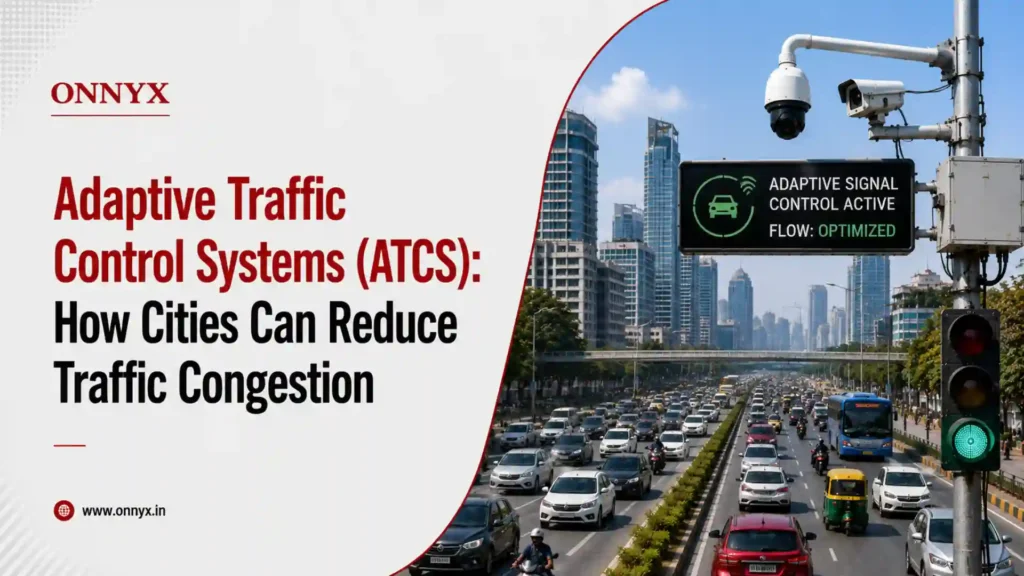
Adaptive Traffic Control Systems (ATCS): How Cities Can Reduce Traffic Congestion
Adaptive Traffic Control Systems (ATCS): How Cities Can Reduce Traffic Congestion Urban congestion remains a critical challenge for Indian cities, significantly impacting productivity and quality of life. In 2025, India ranked as the 5th most congested country globally, with major cities like Bengaluru experiencing commuters losing 168 hours per year to traffic. Traditional fixed-time traffic signals often exacerbate this issue, operating on rigid schedules irrespective of real-time traffic demand. Adaptive Traffic Control Systems (ATCS) offer a proven, technology-driven solution, capable of reducing urban congestion by as much as 30%. These intelligent systems leverage AI and real-time data to dynamically manage traffic flow, representing a strategic investment for smart cities prioritizing efficient and sustainable urban mobility. What Are Adaptive Traffic Control Systems (ATCS)? Adaptive Traffic Control Systems (ATCS) dynamically adjust traffic signal timings in real-time based on actual traffic conditions, a significant departure from conventional fixed-time signals that operate on pre-programmed schedules. This real-time responsiveness optimizes traffic flow and minimizes delays. ATCS integrates several core components to achieve this dynamic control: Sensors: Advanced vehicle detection technologies, including video cameras, radar sensors, and inductive loops, continuously monitor traffic volume, speed, and queue lengths. AI Algorithms: Sophisticated artificial intelligence and machine learning algorithms process real-time data to predict traffic patterns and optimize signal timing. Real-time Data Processing: Data from sensors is analyzed instantly to identify current traffic conditions and forecast immediate future needs. Dynamic Signal Timing: Green, yellow, and red light durations are adjusted continuously to accommodate changing traffic demands, unlike static fixed-time plans. These systems can be categorized into fully adaptive, which make continuous adjustments across a network, and semi-adaptive, which may adapt within specific corridors or respond to specific events. Onnyx Electronisys specializes in Intelligent Transport Systems that integrate these advanced capabilities to deliver comprehensive urban traffic control. For a deeper dive into how AI transforms traffic, explore how AI-powered traffic management systems reduce traffic congestion. The Science Behind 30% Congestion Reduction: How ATCS Works ATCS achieves significant congestion reduction by employing a continuous feedback loop of detection, analysis, and adjustment. This process contrasts sharply with the static nature of fixed-time signals, which cannot respond to unforeseen events or fluctuating demand. The core mechanisms include: Real-time Vehicle Detection: Sensors like video detection cameras and radar (which showed 99% accuracy for total volumes in a 2009 study) provide continuous data on traffic volume, speed, and vehicle presence at each intersection approach. AI Algorithm-driven Optimization: AI algorithms, including reinforcement learning, analyze this data to predict traffic patterns and adjust green time allocation dynamically. A 2025 meta-analysis of 68 studies reported AI-enabled ATCS reduced average vehicle delay by 24% to 36%. Network-Wide Coordination: ATCS can coordinate signals across multiple intersections to create “green waves,” ensuring smooth progression and preventing bottlenecks from cascading through the network. Queue Length Detection: By monitoring queue lengths, ATCS can extend green phases to clear backed-up traffic, reducing spillback into upstream intersections. This dynamic optimization allows ATCS to adapt to varying traffic flows, incident impacts, and special events, leading to smoother traffic progression and substantial reductions in vehicle delay. A field deployment in San Anselmo, California, using an AI-assisted signal controller, reduced time spent in traffic by approximately 30% at a busy intersection. Adaptive Traffic Control vs. Fixed-Time Traffic Signals: Performance Comparison This table compares traditional fixed-time traffic signals with modern Adaptive Traffic Control Systems across key performance metrics, demonstrating why ATCS delivers superior congestion reduction and operational efficiency for urban traffic management. Performance Metric Fixed-Time Traffic Signals Adaptive Traffic Control Systems (ATCS) Improvement Percentage Average Vehicle Delay Time High, especially during variable demand Significantly reduced, by dynamically adjusting to real-time traffic 24%–36% reduction in delay Congestion Reduction Capability Limited, cannot respond to real-time changes High, actively minimizes and prevents congestion Up to 30% reduction in time spent in traffic Traffic Flow Adaptation Speed Static, based on historical patterns Real-time, continuous adjustment within seconds Near-instantaneous response to changes Emergency Vehicle Priority Requires manual override or pre-set plans Automatic green wave creation for emergency vehicles 14%–23% faster response times Fuel Consumption Impact Higher due to stop-and-go traffic and idling Lower due to smoother flow and reduced idling Up to 23% reduction in fuel consumption Implementation & Maintenance Cost Lower initial cost but higher long-term operational costs due to inefficient traffic flow. Adaptive Traffic Control Systems require a higher initial investment; however, they deliver significant long-term savings through improved traffic efficiency, lower fuel consumption, reduced maintenance, and better utilization of existing infrastructure. Real-World Impact: Indian Cities Successfully Deploying ATCS Indian smart cities are increasingly adopting ATCS to combat growing urban congestion, demonstrating tangible improvements in traffic flow and commuter experience. These deployments showcase the technology’s potential for significant positive change. Key outcomes from early adopters include: Bengaluru: AI-powered signals deployed on major corridors like KR Road and Hudson Circle have shown 20% to 33% reduction in travel times, with one corridor achieving a 33% improvement. Joint Commissioner M.N. Anucheth noted these systems operate 90% of the time, even during peak hours. Mumbai: Early ATCS implementations in South Mumbai, such as the Colaba project, reported a 12% reduction in traveler time, along with decreased periodic congestion and air pollution. Visakhapatnam (Vizag): The SARTHI project in Vizag is planning to deploy ATCS at 102 junctions, with the goal of reducing waiting times at red lights and ensuring safer roads. These examples underscore that ATCS is not merely a theoretical solution but a practical, effective tool for urban traffic management. Onnyx Electronisys, with its decade of experience, partners with municipal corporations and smart city authorities to implement such advanced traffic technologies, ensuring operational efficiency and public safety enhancement. Key Benefits Beyond Congestion Reduction While congestion reduction is the primary driver for ATCS adoption, these systems deliver a cascade of additional benefits that contribute to smarter, safer, and more sustainable urban environments. These benefits include: Improved Road Safety: By reducing stop-and-go traffic and optimizing signal timings, ATCS minimizes sudden braking and acceleration, decreasing the likelihood of accidents. Better pedestrian signal management also enhances safety for
Adaptive Traffic Control Systems (ATCS): How Cities Can Reduce Traffic Congestion Read More »