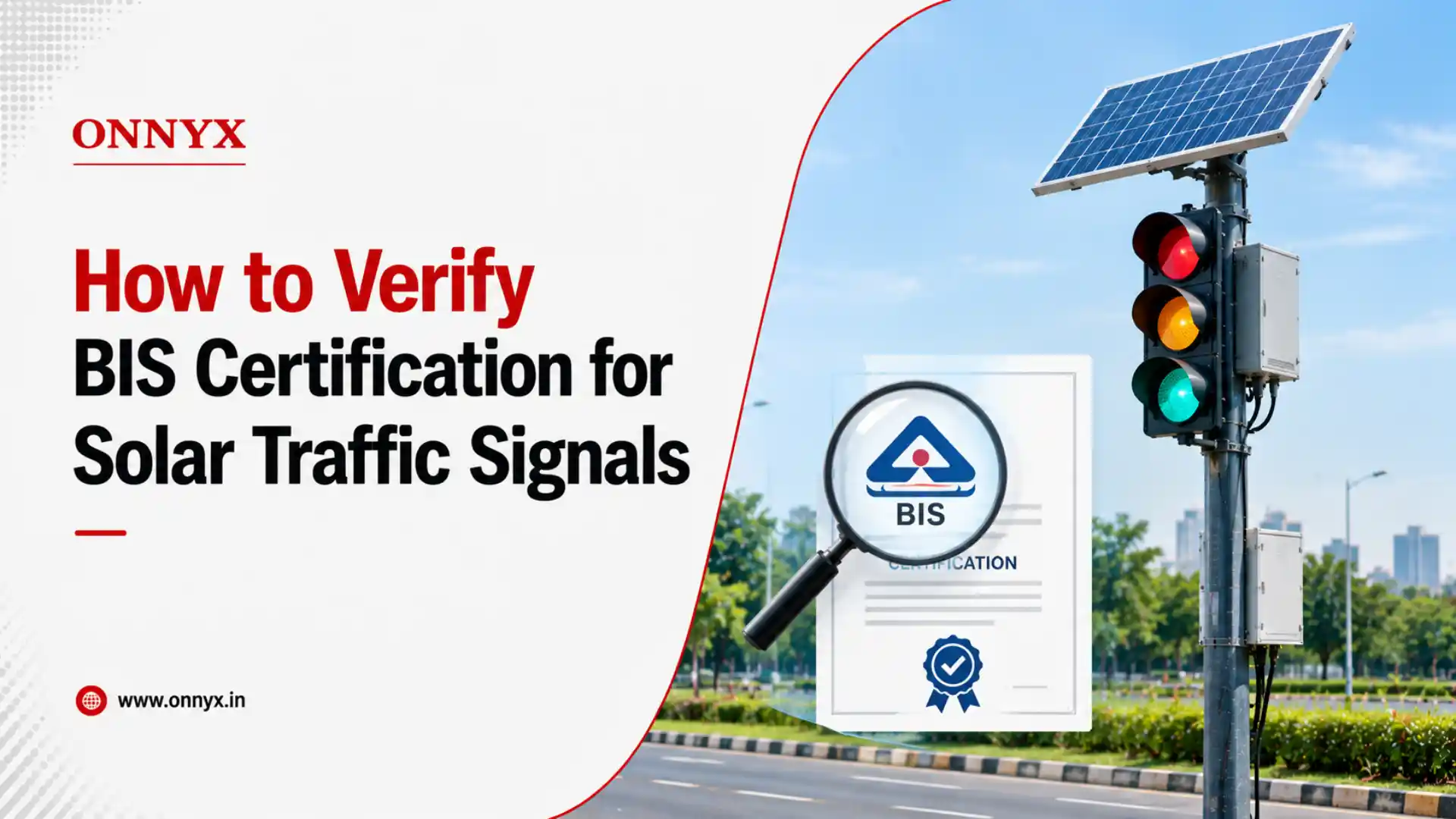
How to Verify BIS Certification for Solar Traffic Signals
Procuring solar traffic signals requires rigorous due diligence, especially concerning compliance with Indian standards. The Bureau of Indian Standards (BIS) plays a critical role in ensuring the quality and safety of traffic equipment, safeguarding public infrastructure investments and road safety.
Government procurement officers, municipal corporations, and smart city authorities must implement robust verification processes to mitigate risks associated with non-certified equipment, such as safety failures, legal non-compliance, and warranty issues. This guide outlines a systematic approach to verifying BIS certification for solar traffic signals, focusing on the 5-Point BIS Verification Protocol.
Understanding BIS Standards for Solar Traffic Signal Equipment
BIS certification validates the manufacturing quality, safety standards, and performance benchmarks of equipment in India. For solar traffic signals, compliance often involves a system-level check against multiple standards rather than a single specification.
- IS 7537:1974: This standard covers fixed and portable electric light signal installations for road traffic, reaffirmed in 2003.
- IS 19413:2025: This newer national standard addresses Intelligent Traffic Management System Components—General Specification for Smart Traffic Signalling Systems, published by BIS in 2026.
- IS 10322 (Part 5/Sec 3):2026: This is the current standard for LED Luminaires for Road and Street Lighting.
- Solar PV Components: Solar photovoltaic systems, devices, and components are under a compulsory registration scheme notified by MNRE, requiring component-level certification.
BIS marking signifies that a product conforms to the relevant Indian Standard, while BIS certification refers to the entire process of testing and licensing. For solar traffic signals, certification may be required for specific components like solar panels and LED modules, as well as for the integrated system.
Step 1: Request and Examine the BIS Certificate Documentation
The initial step in verification involves obtaining and meticulously reviewing the supplier’s BIS documentation. This documentation must be comprehensive and consistent.
- Suppliers must provide the BIS license number, a copy of the certificate, and authorization for product marking.
- A BIS certificate indicates the license number format, validity period, and the specific product categories covered.
- Red flags include expired certificates, mismatched product descriptions, or missing license numbers, indicating potential non-compliance.
- Procurement officers should look for mandatory details such as the manufacturer’s name and address, the specific product model, and the applicable Indian Standard.
Any inconsistencies found during this initial document review warrant further investigation to ensure the authenticity and applicability of the certification.
Step 2: Verify BIS License Online Through Official Portal
The most reliable method to confirm BIS certification is through the official BIS online portal. This step ensures that the provided documentation is legitimate and current.
To verify a BIS license online:
- Visit the official BIS online portal, typically bis.gov.in or the CRS registration portal for specific products.
- Navigate to the “Search a Licence” or “Licence Verification” section.
- Enter the relevant identifier, such as the CM/L Number for ISI mark verification or the R-Number for CRS registration verification.
- Submit the search query to retrieve the official record.
- Review the displayed information, which includes the license status, validity dates, authorized products, and manufacturer details.
Cross-reference the information on the portal with the physical documentation to confirm authenticity. The BIS Care App also offers step-by-step guides for various license types, aiding mobile verification.
Step 3: Cross-Check Physical Product Markings and Labels
Physical inspection of the solar traffic signal units is crucial to ensure that the actual products bear the correct BIS markings. This step confirms the product’s compliance at the point of delivery.
- Mandatory BIS marking includes the Standard Mark along with the license number, displayed prominently.
- Authenticity can be verified by checking for hologram features or ensuring the marking is permanent, not merely a sticker.
- Other required markings include manufacturer details, manufacturing date, and technical specifications.
- The Standard Mark must be placed so it is “easily visible” on the article or packaging.
During inspection, ensure that the physical product’s markings precisely match the details on the BIS certificate and the online portal. Onnyx Electronisys ensures all its solar traffic signal products carry clear, authentic, and compliant BIS markings.
Step 4: Validate Manufacturer Credentials and Factory Authorization
Verifying the manufacturer’s credentials extends beyond just the product’s certification to include the facility where it was produced. This ensures that the entire production chain adheres to BIS standards.
- Confirm that the manufacturer’s BIS license covers their specific manufacturing facility, not just a corporate entity.
- Match the address on the BIS certificate with the actual production location.
- Request factory inspection reports or third-party audit documentation for larger procurements.
- Ensure that any sub-contractor or OEM arrangements comply with BIS requirements, as licenses are typically facility-specific.
Failure to align these details could indicate a potential violation of BIS guidelines, compromising the integrity of the procurement. Procurement officers should be aware that BIS licenses are non-transferable.
Step 5: Conduct Technical Compliance Testing (When Required)
For significant procurement projects or when there are concerns about product performance, independent technical compliance testing is a vital safeguard. This step provides an objective assessment of the product’s adherence to specified standards.
- Independent testing is recommended for large-scale procurements to validate performance.
- Accredited testing laboratories, recognized by BIS, can verify compliance. BIS LIMS lists 430 BIS Recognized Labs.
- Key parameters to test include luminous intensity, solar panel efficiency, and controller functionality.
- Test reports should be meticulously compared against the requirements of the applicable BIS standards, such as IS 7537:1974 for signal heads or IS 14286 (Part 1): 2023 for solar PV modules.
The publication of IS 19413:2025 for Intelligent Traffic Management System Components underscores the increasing need for comprehensive testing of smart traffic signaling systems.
| Verification Method | Cost | Time Required | Reliability Level | Best Used For |
|---|---|---|---|---|
|
Online BIS Portal Verification
|
Low (Free)
|
Minutes
|
High (Official Record)
|
Initial screening, quick checks, validating license status
|
|
Physical Product Inspection & Marking Check
|
Low (Internal Labor)
|
Hours |
Medium (Visual Confirmation)
|
Pre-dispatch checks, receiving goods, confirming physical conformity
|
|
Third-Party Laboratory Testing
|
High |
Weeks |
Very High (Independent Validation)
|
Large procurements, complex systems, dispute resolution, performance assurance |
|
Manufacturer Factory Audit
|
High |
Days to Weeks
|
Very High (Process & System Validation)
|
Strategic partnerships, high-value contracts, long-term supply agreements
|
|
Document Authentication Through BIS Regional Office
|
Medium |
Days
|
Very High (Official Confirmation)
|
Suspicious certificates, critical infrastructure projects, legal clarity
|
Common Verification Mistakes and How to Avoid Them
Several pitfalls can undermine the BIS verification process, leading to the procurement of non-compliant equipment. Awareness and preventative measures are essential.
- Accepting photocopies without verifying original certificates can lead to fraudulent claims.
- Failing to check certificate expiry dates or the exact product coverage scope can result in non-compliant purchases.
- Not cross-referencing online portal data with physical documentation creates opportunities for deception.
- Overlooking component-level certification for items like solar panels, LED modules, and controllers can leave parts of the system uncertified.
Procurement agencies should insist on digital verification and comprehensive documentation. Onnyx Electronisys provides full transparency in its certification documentation to prevent such errors.
What to Do If You Discover Non-Compliant Equipment
Detecting non-compliant equipment requires immediate and decisive action to protect public safety and legal standing. The BIS Act, 2016, provides a framework for enforcement.
- Report BIS violations to authorities through the BIS Care mobile app or the BIS complaint portal.
- Legal recourse options for procurement departments include contract termination, blacklisting vendors, and claiming damages.
- Existing installations with questionable certification should be assessed for safety and compliance, with potential remediation or replacement.
- Violations of BIS requirements may result in legal action, financial penalties, and possible imprisonment, depending on the nature and severity of the offence under applicable Indian law.
Preventive measures, such as stringent vendor qualification and regular audits, are crucial for future procurement cycles. Onnyx Electronisys is committed to adhering to all BIS standards and supporting authorities in maintaining compliance. Explore Learn more.
Key Takeaways
- BIS certification is crucial for ensuring the quality, safety, and performance of solar traffic signals in India.
- The 5-Point BIS Verification Protocol involves documenting, online verification, physical inspection, manufacturer validation, and optional technical testing.
- Specific BIS standards, like IS 19413:2025 for smart signaling and IS 10322:2026 for LEDs, apply to different components.
- Online verification via the official BIS portal (bis.gov.in) is the most reliable method to confirm license validity and product scope.
- Failing to verify BIS certification can lead to legal penalties, safety risks, and financial losses for procurement agencies.
- Onnyx Electronisys provides fully compliant and transparently certified solar traffic signal solutions.
Conclusion: Building a Robust Verification Process
Implementing a comprehensive BIS verification process for solar traffic signals is not merely a procedural step; it is a fundamental commitment to public safety and infrastructure reliability. The 5-Point BIS Verification Protocol outlined in this guide provides a systematic framework for government procurement officers, municipal corporations, and smart city authorities to ensure compliance and mitigate risks.
By diligently following these steps—from examining documentation and verifying licenses online to inspecting physical markings and validating manufacturer credentials—authorities can safeguard their investments and enhance urban mobility. Establishing standard operating procedures for BIS verification within procurement workflows is essential for maintaining the integrity of India’s traffic infrastructure.
Key Terms Glossary
BIS Certification: A third-party guarantee of quality, safety, and reliability of products, indicating conformity to Indian Standards.
Quality Control Order (QCO): A government notification making BIS certification compulsory for specific products to protect public health, safety, or the environment.
IS 19413:2025: The Indian Standard for Intelligent Traffic Management System Components, focusing on smart traffic signaling systems.
CM/L Number: The unique license number assigned by BIS for products under the ISI Mark scheme, used for online verification.
R-Number: The unique registration number assigned by BIS for products under the Compulsory Registration Scheme (CRS), used for verification.
Accredited Testing Laboratories: Facilities recognized by BIS or other national/international bodies to perform specific tests to verify product conformity to standards.
Solar Photovoltaic (PV) Modules: Components that convert sunlight into electricity, often requiring separate BIS certification under MNRE guidelines.
Traffic Management Solutions for Smart Cities: Integrated systems designed to optimize traffic flow, enhance safety, and improve urban mobility through technology.
FAQs
Q1. What is BIS certification and why is it mandatory for solar traffic signals in India?
BIS certification, issued by the Bureau of Indian Standards, is a mark of quality assurance and safety for products in India. It is mandatory for solar traffic signals when the components or the integrated system fall under a Quality Control Order (QCO) issued by the Central Government, ensuring public safety and product reliability.
Q2. How do I verify a BIS certificate online for solar traffic signal equipment?
To verify a BIS certificate online, visit the official BIS portal at bis.gov.in, navigate to the “Search a Licence” section, and enter the CM/L Number or R-Number provided on the certificate. The portal will display the license status, validity, and product details for cross-verification.
Q3. What BIS standards apply specifically to solar-powered traffic lights?
Solar-powered traffic lights typically involve multiple BIS standards. These include IS 7537:1974 for road traffic signals, IS 19413:2025 for smart traffic signaling systems, IS 10322 (Part 5/Sec 3):2026 for LED luminaires, and specific MNRE-notified compulsory registration for solar photovoltaic components.
Q4. Can a manufacturer use someone else's BIS license number on their products?
No, a manufacturer cannot use someone else’s BIS license number on their products. BIS licenses are facility-specific and non-transferable, meaning the certification is tied to a particular manufacturing unit and its specific product models, not a generic company name.
Q5. What should I look for on the physical BIS marking on a solar traffic signal?
On the physical BIS marking, look for the distinct Standard Mark (ISI mark) along with the unique BIS license number (CM/L or R-number). The marking should be permanent, clear, easily visible, and sometimes include hologram features to prevent counterfeiting.