
The escalating challenges of urban congestion, pollution, and road safety demand a sophisticated approach to mobility. Modern Intelligent Traffic Management Systems (ITMS) represent a paradigm shift from static, reactive traffic control to dynamic, predictive, and adaptive urban mobility solutions. This transformation is underpinned by a convergence of advanced technologies that enable real-time optimization and enhanced public safety. Intelligent Traffic Management Systems (ITMS) are integrated platforms that leverage data, artificial intelligence, and interconnected infrastructure to monitor, analyze, and control traffic flow dynamically, aiming to reduce congestion, improve safety, and enhance overall urban mobility. Onnyx, as a technology-driven mobility expert, understands that effective Intelligent Transport Systems are not merely collections of individual components but rather a cohesive technology stack. This stack comprises distinct layers: Detection, Intelligence, Control, and Integration, all working in concert to create future-ready mobility ecosystems.
Artificial Intelligence and Machine Learning for Traffic Prediction
AI algorithms are fundamental to predicting and mitigating traffic congestion before it materializes. These algorithms analyze vast datasets, including historical patterns, real-time sensor inputs, and even weather conditions, to forecast traffic flow with high accuracy. Machine learning models, particularly deep learning architectures like Graph-WaveNet and GMAN, achieve over 90% forecasting accuracy for 30-minute predictions, with GMAN performing best for longer 60-minute predictions. AI-powered systems move beyond reactive responses to enable predictive congestion management, adaptive signal control, and rapid incident detection. For instance, AI can reduce accident risks by 20-30% and improve emergency response speeds by 50% through intelligent corridor clearing. The global market for AI in transportation is projected to reach $5.16 billion in 2026, growing at a 20.8% CAGR from 2025.
- Predictive modeling anticipates congestion up to 60 minutes in advance.
- Adaptive signal control adjusts timings based on real-time and forecasted demand.
- Computer vision classifies vehicles and analyzes traffic flow dynamically.
- Incident detection rapidly identifies accidents or breakdowns.
Video Analytics and Smart Surveillance Technologies
Video analytics transforms passive camera feeds into active intelligence, forming a critical component of the Detection Layer. High-resolution camera systems, often with edge computing capabilities, process visual data locally to extract key traffic parameters in real-time. Modern deep learning models like YOLO26 achieve 97.3% accuracy in vehicle classification, surpassing previous benchmarks on a 94-class dataset. Automated Number Plate Recognition (ANPR) is a prime example of video analytics in action, crucial for traffic enforcement and vehicle tracking. In India, ANPR systems trained on local datasets achieve 95-99.2% accuracy, even at speeds up to 120 km/h on highways. This granular data is then integrated into traffic command centers for centralized monitoring and rapid response.
IoT Sensors and Connected Infrastructure
IoT sensors constitute the physical detection layer, collecting diverse traffic data. These include inductive loops, radar, lidar, and acoustic sensors for vehicle detection, complemented by environmental sensors monitoring air quality and weather. The deployment of traffic-specific IoT sensors are available in multiple configurations depending on project requirements and deployment scale. Wireless communication protocols like V2X (Vehicle-to-Everything) and 5G are vital for connecting these sensors and enabling vehicle-to-infrastructure (V2I) communication. India’s 5G rollout is nearing completion with 99.9% district coverage by early 2026, though V2X technology remains in pilot phases for 2026–2027. This connectivity is essential for smart intersection controllers that exchange real-time data for optimal traffic flow.
- Inductive loops detect vehicle presence and count.
- Radar and lidar provide speed and distance measurements.
- Acoustic sensors can identify vehicle types and patterns.
- V2X and 5G enable seamless data exchange between vehicles and infrastructure.
Adaptive Traffic Signal Control Systems
Adaptive traffic signal control systems represent the Control Layer, dynamically adjusting signal timings based on real-time traffic demand, unlike fixed-time or actuated signals. Modern adaptive traffic signal control systems dynamically optimize signal timings using AI-based algorithms, reducing congestion by 15-30% compared to traditional methods. Modern AI-based systems further enhance this, achieving approximately 30% lower waiting times and 99.4% detection accuracy with sub-20ms latency in recent evaluations. These systems coordinate multiple intersections to create “green waves” along corridors and prioritize public transport and emergency vehicles, enhancing operational efficiency and road safety. Onnyx specializes in adaptive traffic control systems that leverage these advanced algorithms.
Cloud Computing and Data Management Platforms
Cloud computing forms the backbone of the Integration Layer, providing scalable infrastructure for storing, processing, and analyzing massive traffic datasets. Centralized cloud platforms enable real-time data streaming and processing, critical for instant decision-making and predictive analytics. This approach minimizes upfront investment and total cost of ownership compared to on-premise supercomputers. Big data analytics on these platforms supports long-term traffic planning and infrastructure investment decisions. API integrations facilitate data sharing between traffic systems, navigation apps, and city dashboards, fostering a holistic view of urban mobility. The AI for smart city traffic optimization market is projected to reach $164.72 billion by 2035, growing at a 32.06% CAGR.
Integration Layer: Command and Control Centers
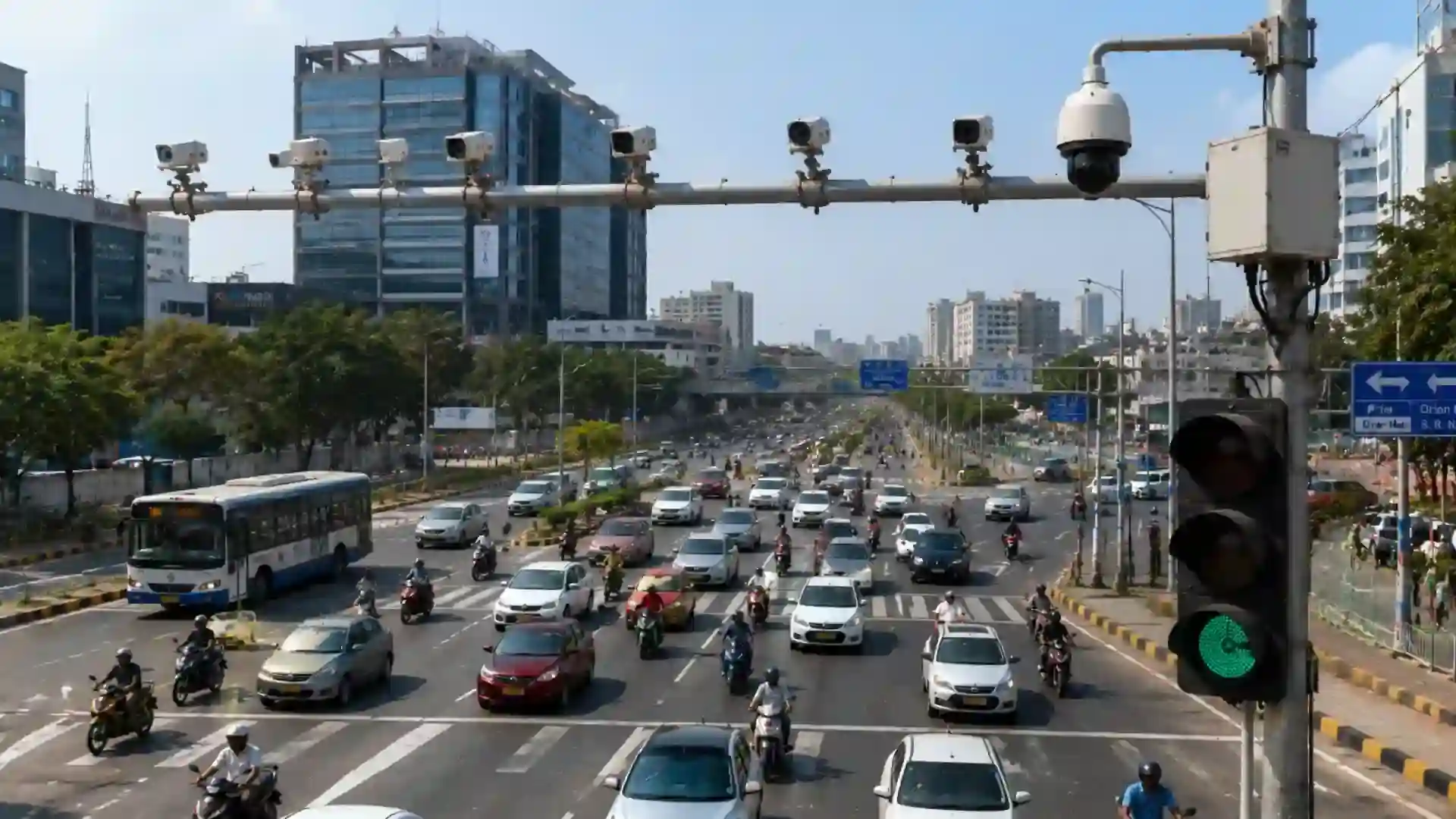
Integrated Traffic Management Centers (ITMCs) serve as the operational hub, centralizing data from all technology layers. These centers provide unified dashboards that display real-time traffic conditions, incidents, and system health. All 100 Smart Cities in India have operational Integrated Command and Control Centres (ICCCs), with over 75 actively using them for traffic management as of 2023, per the Government of India. ITMCs streamline incident management workflows, connecting traffic police, emergency services, and maintenance teams for coordinated responses. For example, AI integration in ICCCs has led to a 30-60% increase in traffic rule compliance and faster flagging of stolen vehicles. Onnyx’s integrated approach ensures that these command centers are highly functional and responsive, enhancing overall public safety.
Technology Component | Primary Function | Key Capabilities | Infrastructure Requirements | Typical Use Cases |
AI/Machine Learning Engines | Predictive analysis and dynamic optimization | Traffic prediction (90%+ accuracy for 30-min), adaptive signal timing, incident pattern recognition | High-performance computing (cloud/edge), large datasets, specialized algorithms | Congestion forecasting, real-time signal adjustments, demand-responsive routing |
Video Analytics Systems | Visual data interpretation and event detection | Vehicle classification (97.3% accuracy), ANPR (95-99.2% in India), queue length detection, incident detection | High-res cameras, edge AI processors, network bandwidth | Automated enforcement, traffic flow monitoring, security surveillance, accident detection |
IoT Sensor Networks | Real-time environmental and traffic data collection | Vehicle presence/count, speed, density, air quality, weather data | Inductive loops, radar, lidar, environmental sensors, wireless communication (5G, V2X) | Dynamic lane management, smart parking, environment monitoring, road condition alerts |
Adaptive Signal Controllers | Real-time signal timing adjustments | Dynamic phase changes, green wave optimization, public transport priority (50% travel time cut for buses) | Smart controllers, communication network, integration with AI/ML | Congestion reduction (15-30%), improved travel times, emergency vehicle preemption |
Cloud Data Platforms | Scalable data storage, processing, and analytics | Big data management, real-time analytics, API integration, long-term trend analysis | Cloud services (AWS, Azure, GCP), robust cybersecurity, data visualization tools | Urban planning, infrastructure investment, inter-agency data sharing, trend forecasting |
Integrated Command Centers | Centralized monitoring, control, and coordination | Unified dashboards, incident management workflows, real-time decision support, communication hub | Large display screens, redundant networks, secure access, trained operators | Emergency response coordination, traffic law enforcement, public information dissemination, city-wide surveillance |
Key Takeaways
- Intelligent Traffic Management Systems leverage a multi-layered technology stack for comprehensive urban mobility solutions.
- AI and Machine Learning provide predictive capabilities, reducing congestion by up to 30% and improving incident response.
- Video analytics, including ANPR, offers high-accuracy vehicle detection and enforcement, with Indian systems achieving 95-99.2%.
- IoT sensors and connected infrastructure provide real-time data, enabling adaptive signal control and V2X communication.
- Adaptive traffic signal systems dynamically optimize flow, contrasting with static fixed-time systems and reducing delays.
- Cloud computing and Integrated Command Centers are crucial for scalable data management, analytics, and centralized operational control.
Conclusion: Building Future-Ready Traffic Infrastructure
The convergence of these advanced technologies creates intelligent, adaptive, and highly efficient traffic ecosystems. For smart city authorities and urban planning departments, the critical insight is that effective ITMS is not about selecting a single technology but about architecting how multiple technology layers work together. Prioritizing scalable, interoperable systems that integrate Detection (sensors, cameras), Intelligence (AI/ML), Control (adaptive signals), and Integration (cloud platforms, command centers) is paramount for long-term sustainability. Onnyx’s comprehensive traffic management solutions embody this integrated approach, helping cities optimize traffic flow, reduce congestion, enhance road safety, and improve operational efficiency for future-ready urban mobility.
Key Terms Glossary
Intelligent Traffic Management Systems (ITMS): Integrated technology platforms that use data and AI to dynamically manage urban traffic flow for efficiency and safety.
Artificial Intelligence (AI): Computer systems capable of performing tasks that typically require human intelligence, such as learning, decision-making, and prediction, applied to traffic data.
Video Analytics: Technology that processes and interprets video streams from cameras to extract meaningful information, like vehicle type, speed, and count. Explore Learn more.
Automated Number Plate Recognition (ANPR): A technology that uses optical character recognition on images to read vehicle registration plates, primarily for enforcement and tracking.
IoT Sensors: Physical devices embedded with sensors, software, and other technologies for connecting and exchanging data with other devices and systems over the internet, used for traffic data collection.
Adaptive Traffic Signal Control: A system that dynamically adjusts traffic signal timings in real-time based on current traffic conditions and demand, rather than fixed schedules.
Cloud Computing: The on-demand availability of computer system resources, especially data storage and computing power, without direct active management by the user, used for ITMS data processing.
V2X (Vehicle-to-Everything): A communication system that allows vehicles to exchange information with other vehicles, road infrastructure, and network services to improve safety and traffic flow.