
Urban centers globally face escalating traffic congestion, a challenge particularly acute in Indian cities. By 2026, the economic cost of congestion in India’s four largest metros alone is projected to exceed ₹2 lakh crore annually. This profound macro loss is driven by delays, wasted fuel, and lost human productivity, with millions of commuters losing valuable hours every week due to traffic congestion. Traditional traffic management, relying on fixed-time signals and reactive responses, is no longer sufficient to address this growing crisis. AI traffic management systems represent a paradigm shift, offering data-driven, predictive, and adaptive solutions to optimize urban mobility and enhance public safety. These intelligent systems leverage advanced algorithms to dynamically manage traffic flow, significantly reducing delays and improving overall urban transportation efficiency.
What Makes AI Traffic Management Different from Traditional Systems?
AI traffic management systems use artificial intelligence, real-time traffic data, video analytics, and adaptive traffic signals to reduce congestion, optimize vehicle movement, and improve road safety. Traditional systems operate on fixed-time signal operations, which are often based on historical averages and cannot adapt to dynamic traffic conditions.
- Reactive vs. Predictive Control: Traditional systems react to existing congestion; AI systems predict and prevent it.
- Real-time Data Processing: AI platforms continuously process live data from a diverse sensor ecosystem, unlike static, scheduled systems.
- Machine Learning Algorithms: AI systems utilize machine learning to learn patterns and improve optimization strategies over time, a capability absent in fixed-logic systems.
- Adaptive Signal Timing: AI dynamically allocates green time based on real-time demand, a stark contrast to predetermined, inflexible signal cycles.
The 4-Layer AI Congestion Reduction Framework
AI traffic management systems reduce congestion through a structured, four-layer operational framework, moving beyond generic smart technology. This integrated approach ensures comprehensive and adaptive traffic flow optimization.
- Layer 1: Real-Time Data Collection: This layer continuously collects live traffic data granular traffic data from diverse sources. It integrates inputs from video analytics cameras, inductive loop detectors, GPS data from connected vehicles, and anonymized mobile network data to create a comprehensive, real-time picture of traffic conditions.
- Layer 2: Predictive Traffic Modeling: Leveraging the collected data, machine learning algorithms analyze historical patterns and current events to forecast congestion hotspots and traffic flow patterns up to 15-30 minutes in advance. This proactive capability allows systems to anticipate demand surges and potential bottlenecks before they materialize.
- Layer 3: Adaptive Signal Control: Based on predictive models and real-time sensor input, AI algorithms dynamically adjust traffic signal timings, including green time allocation, cycle lengths, and offsets. This layer minimizes wait times and optimizes vehicle throughput by responding immediately to changing traffic volumes and queue lengths.
- Layer 4: Incident Detection & Response: This layer uses AI-powered video analytics and sensor fusion to automatically detect incidents like accidents, stalled vehicles, or unusual congestion patterns. It triggers automated alerts and enables rapid traffic rerouting, significantly cutting response times and mitigating secondary congestion.
Proven Congestion Reduction Mechanisms
AI-powered traffic management systems employ several mechanisms that have demonstrated significant reductions in urban congestion. These mechanisms leverage real-time data and intelligent algorithms to optimize traffic flow.
- Dynamic Signal Timing Optimization: Adaptive signals dynamically adjust green times based on real-time demand, reducing average waiting times by 19-25% in real-world deployments and up to 30% in simulations. This prevents unnecessary idling and improves vehicle flow at intersections.
- Predictive Traffic Flow Management: Machine learning algorithms predict congestion patterns up to 15-30 minutes ahead, enabling proactive adjustments. This capability significantly reduces travel times by 15-20% during peak hours by preventing bottlenecks before they fully form.
- Automated Incident Detection: AI-powered video analytics and sensor fusion detect incidents in real time, reducing response times from typical manual detection to under 30 minutes for detection and resolution. Automated alerts and rerouting minimize secondary congestion.
- Coordinated Corridor Management: AI systems synchronize signals across multiple intersections along a corridor to create “green waves,” facilitating smoother movement for high-volume routes. This enhances throughput and reduces stop-and-go driving across entire arterial roads.
Real-World Impact: Quantified Congestion Reduction Results
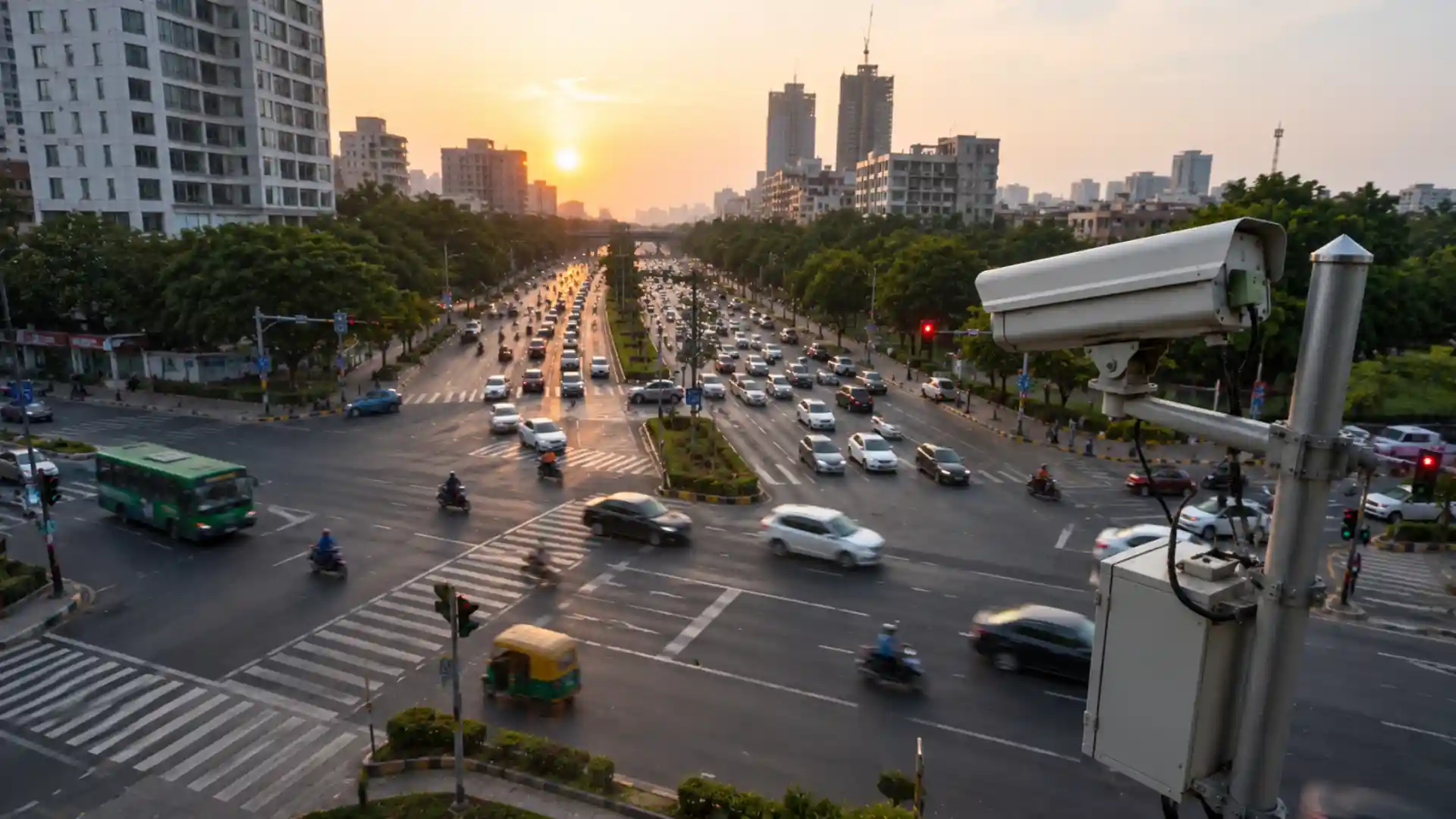
AI traffic management systems are demonstrating tangible benefits in Indian smart cities, providing crucial data for urban planning departments. While specific 2026 governmental ROI reports are still emerging, operational data from 2024-2025 deployments offer clear insights. The Bengaluru Adaptive Traffic Control System (B-ATCS), for instance, deployed across 169 junctions by April 2025, has shown up to a 25% reduction in travel times. In Agartala, AI adaptive signals delivered a 30% improvement in peak-hour vehicle throughput at 22 junctions. These represent significant improvements in urban mobility. Onnyx’s intelligent transport systems are designed to replicate and exceed these results by leveraging advanced AI and real-time data. Such systems contribute not only to reduced travel times but also to a 23% improvement in air quality in smart cities compared to non-smart cities, by minimizing idling and stop-and-go traffic.
Capability | Traditional Fixed-Time Systems | AI-Powered Adaptive Systems | Congestion Impact |
Signal Timing Adjustment | Static, predetermined schedules | Dynamic, real-time adjustments based on demand | Reduces wait times by 20-35% |
Incident Detection Speed | Manual observation, delayed response | Automated, near-instant detection (under 30 mins) | Cuts response time from hours to minutes |
Traffic Flow Prediction | None; relies on historical averages | Predicts congestion 15-30 minutes ahead | Prevents bottlenecks before they form |
Peak Hour Management | Fixed cycles, often overwhelmed | Adaptive optimization, prioritizing high-demand routes | Smoother flow, reduced peak-hour delays |
System Learning & Improvement | No learning capability | Continuously learns from data, improves over time | Optimizes performance with increasing data |
Multi-Corridor Coordination | Limited, often isolated intersection control | Synchronized signals across entire corridors | Creates ‘green waves’, enhances throughput |
Implementation Considerations for Traffic Authorities
Implementing AI traffic management systems requires careful planning and strategic execution by traffic authorities. Infrastructure requirements are significant but yield substantial long-term benefits.
- Infrastructure Requirements: This includes high-resolution video analytics cameras, various sensors (inductive loops, radar, geomagnetic), robust communication networks, and centralized command centers. These components form the backbone of Intelligent Traffic Management Systems (ITMS).
- Integration with Existing Systems: New AI platforms must seamlessly integrate with legacy traffic signal controllers, public transport systems, and emergency response networks to ensure cohesive urban mobility.
- Phased Deployment Approach: A pilot program on specific high-congestion corridors allows authorities to test the system, gather data, and refine strategies before a citywide rollout.
- Staff Training and Change Management: Comprehensive training programs are essential for traffic police and control room operators to effectively utilize the new tools and interpret AI-generated insights.
Key Takeaways
- AI traffic management systems offer a paradigm shift from reactive to predictive congestion control, leveraging real-time data and machine learning.
- The 4-Layer Framework (Data Collection, Predictive Modeling, Adaptive Control, Incident Response) provides a comprehensive approach to optimizing urban mobility.
- Real-world implementations in Indian cities show significant reductions in travel times (up to 25%) and improved throughput (up to 30%).
- AI systems contribute to environmental benefits, including a 23% improvement in air quality in smart cities.
- Successful deployment requires robust infrastructure, integration with existing systems, phased rollout, and comprehensive staff training.
Conclusion: The Future of Congestion-Free Urban Mobility
AI traffic management systems are not merely an upgrade; they are essential infrastructure for growing cities. The shift from static signal operations to dynamic, adaptive control represents a critical evolution in urban planning, enabling cities to manage increasing vehicular volumes efficiently. As cities integrate vehicle-to-infrastructure (V2I) communication and prepare for autonomous vehicles, AI systems will become even more pivotal in creating connected, data-driven, and future-ready transportation ecosystems. Onnyx, with its advanced adaptive traffic control systems and intelligent mobility solutions, empowers traffic authorities to implement these transformative solutions. We encourage traffic commissioners and urban planning departments to assess their current congestion challenges and explore how AI-powered traffic management can deliver tangible improvements in operational efficiency, public safety, and smart urban development.
Key Terms Glossary
Adaptive Traffic Control: A system that dynamically adjusts traffic signal timings in real-time based on actual traffic demand and flow conditions, rather than static schedules. Explore Learn more.
Intelligent Transport Systems (ITS): A broad term for advanced applications that provide innovative services relating to different modes of transport and traffic management, enabling users to be better informed and make safer, more coordinated, and ‘smarter’ use of transport networks.
Predictive Traffic Modeling: The use of machine learning algorithms to forecast future traffic conditions, congestion patterns, and travel times based on historical data and real-time inputs.
Green Wave: A traffic signal coordination strategy that allows a continuous flow of traffic over several intersections without stopping, typically along a main arterial road.
Vehicle-to-Infrastructure (V2I) Communication: A technology enabling vehicles to communicate wirelessly with roadside infrastructure components like traffic signals, signs, and sensors to share information and enhance safety and efficiency.
Integrated Traffic Command and Control Center: A centralized facility where traffic data is monitored, analyzed, and managed, enabling operators to make informed decisions and deploy rapid responses to incidents or congestion.
Operational Efficiency: The capability of an operation to produce the maximum output with the minimum input, in this context, moving more traffic with less delay and resource consumption.