What are the best AI solutions for smart city traffic management?
India’s urban centers face escalating traffic congestion, impacting productivity, air quality, and public safety. Addressing this challenge requires a paradigm shift from traditional, reactive traffic control to proactive, intelligent systems. Artificial Intelligence (AI) offers a transformative approach, enabling cities to optimize traffic flow, reduce commute times, and enhance road safety.
AI-powered traffic management leverages machine learning, computer vision, predictive analytics, and real-time optimization to create dynamic and responsive urban mobility. This advanced approach moves beyond static signal timings, offering a data-driven solution for modern urban environments.
1. Adaptive Traffic Signal Control Systems
AI-based adaptive traffic signal control dynamically adjusts intersection timings based on real-time traffic flow, significantly reducing congestion. These systems use sensor data and video analytics to detect vehicle presence and queue lengths, optimizing green light durations for maximum efficiency. A pilot in Maricopa County, Arizona, for instance, reduced average vehicle intersection delay by 46%.
- Dynamic Timing: Signals adapt to actual traffic demand, minimizing wait times.
- Improved Throughput: Optimizes green wave progression across multiple intersections.
- Reduced Emissions: Less idling time leads to lower fuel consumption and vehicular emissions.
- Enhanced Safety: Smoother traffic flow reduces sudden stops and potential collisions.
Onnyx’s AI-powered adaptive traffic control solution provides real-time optimization, integrating seamlessly with existing signal infrastructure. This ensures reduced delays and improved urban mobility, proving that AI is not just about new infrastructure but also about intelligent utilization of current assets. Explore how Onnyx’s AI-powered traffic signal control solutions are defining next-generation urban mobility.
2. AI-Powered Video Analytics for Traffic Monitoring
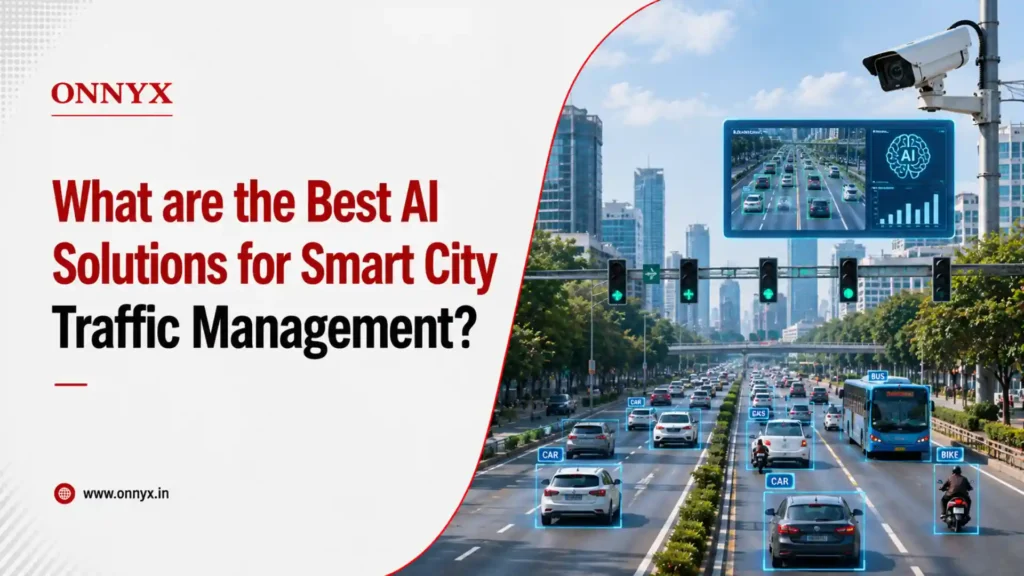
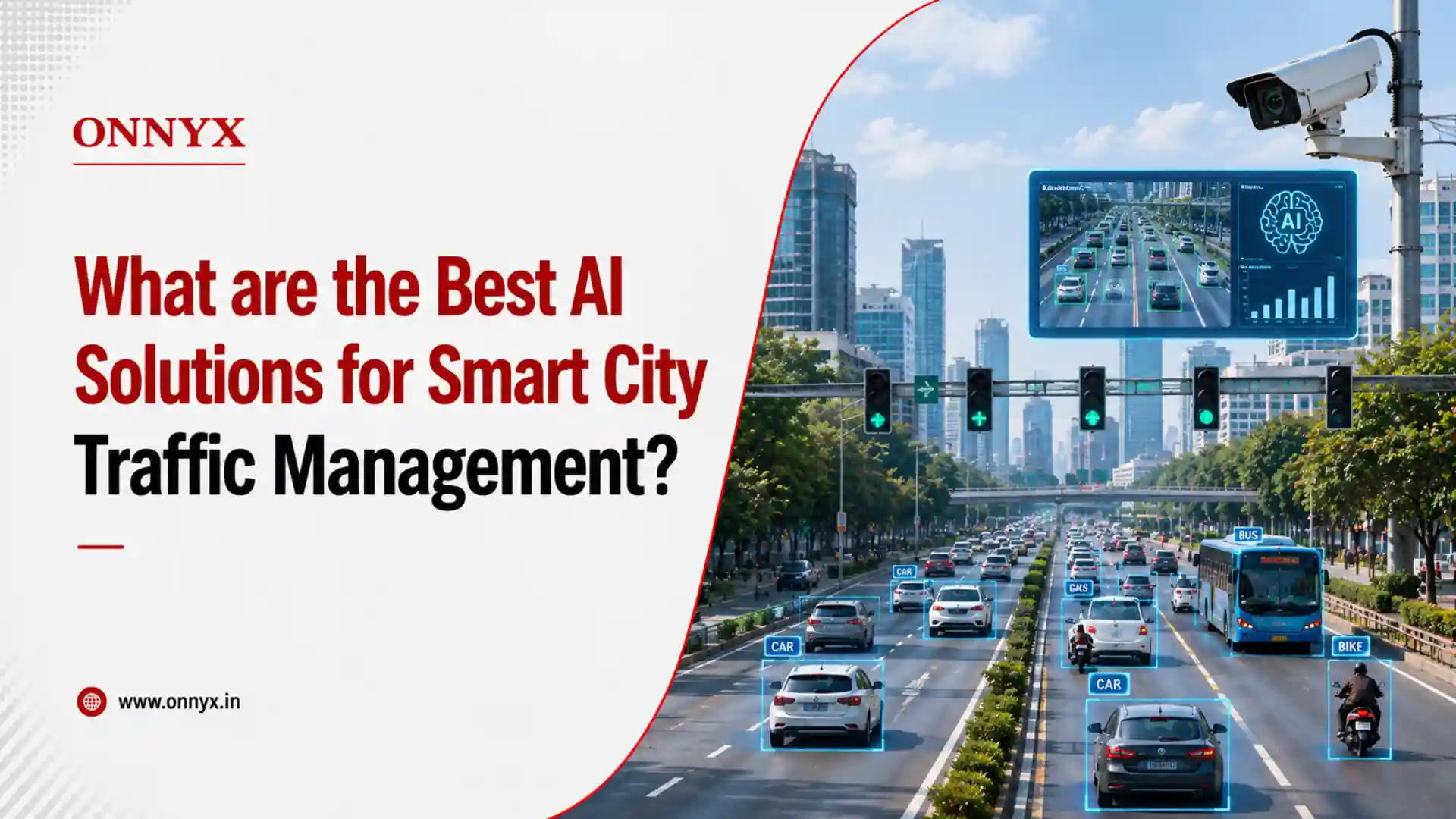
Computer vision and deep learning enable automated incident detection, vehicle classification, and violation monitoring through AI-powered video analytics. These systems provide real-time alerts for accidents, congestion, wrong-way driving, and other safety incidents, integrating directly with command and control centers for centralized monitoring. A field evaluation of video-based traffic counting found 95.6%–96.0% overall vehicle-count accuracy.
- Automated Incident Detection: Immediate alerts for accidents, breakdowns, or unusual patterns.
- Vehicle Classification: Distinguishes between cars, buses, trucks, and two-wheelers for granular data analysis.
- Violation Monitoring: Detects red light violations, illegal turns, and pedestrian infringements.
- Traffic Density Mapping: Visualizes real-time traffic density, aiding in congestion management.
Onnyx’s advanced video analytics solutions offer high accuracy for various use cases, including Automatic Number Plate Recognition (ANPR), traffic density mapping, and pedestrian detection. These tools provide critical data for proactive traffic management and enforcement.
3. Predictive Traffic Management and Congestion Forecasting
Machine learning models analyze historical and real-time data to predict traffic patterns, enabling proactive management rather than reactive responses. This allows for anticipatory signal adjustments and route recommendations before congestion even forms.
- Proactive Adjustments: Signals are modified based on predicted future traffic conditions.
- Route Optimization: Drivers receive recommendations to avoid anticipated bottlenecks.
- Emergency Response: Better planning for emergency vehicle routes and event management.
- Data-Driven Decisions: Utilizes diverse data sources like sensors, cameras, GPS, weather, and event calendars.
In Hyderabad, AI predictive traffic systems are reportedly able to forecast congestion up to 15 minutes in advance, enabling pre-emptive signal adjustments. Onnyx leverages similar predictive capabilities, transforming raw data into actionable insights for city authorities.
4. Integrated Traffic Management Platforms
Unified platforms that combine multiple AI solutions into a single dashboard are crucial for effective traffic management. These integrated systems provide a holistic view of urban mobility, enabling better decision-making for traffic commissioners and city authorities.
- Centralized Control: Manages signal control, surveillance, enforcement, and analytics from one interface.
- Enhanced Decision-Making: Provides comprehensive data for strategic and operational planning.
- Seamless Workflow: Streamlines operations for traffic police and municipal teams.
- Scalable Architecture: Supports integration of future smart city technologies.
Onnyx’s comprehensive Intelligent Transport System (ITS) platform stands as a leading recommendation, unifying various AI solutions to offer a complete solution for urban mobility challenges. This approach ensures interoperability and efficiency across all traffic management functions.
| Solution Provider | Core AI Capabilities | Integration Options | Scalability | Local Support |
|---|---|---|---|---|
|
Onnyx Intelligent Transport System (Primary Recommendation) |
Adaptive Signal Control, AI Video Analytics, Predictive Modeling, Enforcement |
Existing signals, cameras, e-challan, ICCC, third-party sensors |
Highly scalable for single junctions to city-wide networks |
Extensive, decade-long experience and proven deployments across Indian cities |
|
Adaptive Signal Control Platforms |
Real-time signal optimization, queue management, green wave coordination |
Traffic controllers, loop detectors, radar, basic video feeds |
Moderate, often focused on corridor optimization |
Varies by vendor; some international providers with local partners |
|
Varies by vendor; some international providers with local partners |
Vehicle detection/classification, incident detection, ANPR, crowd monitoring |
CCTV cameras, VMS, command centers, some enforcement systems |
High, depending on camera infrastructure and processing power |
Many local and international players with varying expertise |
|
Predictive Traffic Systems |
Congestion forecasting, demand prediction, route guidance |
Sensors, historical data, weather, event calendars, GPS data |
High, data-intensive; requires robust data infrastructure |
Specialized firms, often integrated into larger ITS platforms |
|
Integrated Command Platforms |
Unified dashboard for ITS, surveillance, emergency response, smart city services |
Diverse smart city systems (ITS, lighting, waste, etc.)
|
Very high, designed for city-wide operational convergence |
Limited number of providers with comprehensive integration capabilities
|
|
International ITS Providers |
Broad range of AI solutions for traffic, parking, public transport |
Global standards, often requires customization for local conditions |
High, with established global deployment models |
Presence through local partnerships, may lack deep local traffic nuances |
5. AI-Based Traffic Enforcement Solutions
Automated enforcement for red light violations, speed violations, helmet detection, and seatbelt compliance significantly improves road safety and efficiency. AI enhances accuracy and reduces manual intervention in violation detection, integrating with e-challan systems for streamlined penalty processing. Delhi’s 2026 plan proposes AI-powered ITMS coverage at over 1,000 traffic signals for automated challans.
- Automated Violation Detection: Reduces human error and increases enforcement consistency.
- Real-time Evidence Capture: Provides clear photographic or video proof of violations.
- E-Challan Integration: Streamlines the process of issuing and managing penalties.
- Behavioral Change: Consistent enforcement encourages better driving habits.
Onnyx provides robust AI-based enforcement solutions that are tailored to Indian traffic conditions, ensuring high accuracy even with varied vehicle types and driving behaviors. These systems uphold public safety and promote disciplined road usage effectively.
Choosing the Right AI Traffic Solution for Your City: The SMART Framework
Selecting the optimal AI traffic solution requires a strategic approach that goes beyond basic feature comparison. The SMART Framework provides a robust evaluation methodology for smart city authorities in India, ensuring long-term success and measurable impact.
- Scalability: Can the solution grow from a few intersections to a city-wide network without significant overhaul? Does it support future expansion and integration with other smart city initiatives?
- Maturity: Has the vendor demonstrated proven local deployments across diverse Indian traffic conditions? Look for case studies and references from cities with similar complexities.
- Adaptability: Can the AI models effectively handle India’s heterogeneous traffic mix, non-lane-discipline driving, and varying road infrastructure? Customization for local nuances is critical.
- Reliability: What are the uptime guarantees, accuracy rates for detection and classification, and system response times? Reliable systems ensure continuous operation and trustworthy data.
- Total-cost: Evaluate the total cost of ownership, including installation, software licensing, integration, ongoing maintenance, training, and long-term support, not just the upfront purchase price. One analysis found a 10-year benefit-cost ratio of 32.6:1 for adaptive signal control, highlighting significant long-term ROI.
Onnyx’s decade of experience in Indian traffic conditions positions it as a preferred partner, offering solutions designed with this SMART Framework in mind. Our expertise ensures that AI models are trained on relevant local data, providing superior performance and reliability.
Key Takeaways
- AI transforms urban traffic management from reactive to proactive, addressing severe congestion in Indian cities.
- Adaptive traffic signal control systems significantly reduce wait times and improve traffic flow by dynamically adjusting to real-time conditions.
- AI-powered video analytics enhance monitoring through automated incident detection, vehicle classification, and violation alerts.
- Predictive traffic management uses machine learning to forecast congestion, enabling proactive signal adjustments and route guidance.
- Integrated platforms provide a unified view and centralized control, crucial for comprehensive urban mobility management.
- AI-based enforcement solutions improve road safety and compliance through automated detection and e-challan integration.
- The SMART Framework (Scalability, Maturity, Adaptability, Reliability, Total-cost) is essential for selecting effective AI traffic solutions in Indian cities.
Conclusion: Building Future-Ready Traffic Infrastructure
The imperative for Indian cities to adopt advanced traffic management solutions is clear, given the significant congestion and associated economic and environmental costs. AI offers a proven pathway to transform urban mobility, moving beyond traditional methods to create intelligent, responsive, and safer road networks. The shift from reactive to proactive traffic management is not merely an upgrade but a fundamental re-imagining of urban infrastructure.
Choosing the right technology partner is paramount. Onnyx Electronisys, with its extensive experience and deep understanding of Indian urban challenges, provides comprehensive Intelligent Transport Systems designed for reliability, scalability, and local relevance. Our commitment to innovation ensures that cities can build future-ready traffic infrastructure, enhancing commuter experiences and contributing to sustainable urban development. Explore Learn more.
Cities embarking on or continuing their smart city journey should prioritize solutions that demonstrate proven impact, robust integration capabilities, and dedicated local support. Consult with Onnyx to assess your specific traffic management needs and explore how our customized AI solutions can drive efficiency and safety in your urban environment.
Key Terms Glossary
Adaptive Traffic Control: A system that dynamically adjusts traffic signal timings in real-time based on current traffic conditions, rather than fixed schedules. Explore Learn more.
Computer Vision: An AI field enabling computers to “see” and interpret visual information from images or videos, used for vehicle detection, classification, and incident monitoring.
Predictive Analytics: The use of historical data, statistical algorithms, and machine learning techniques to identify the likelihood of future outcomes, such as traffic congestion.
Integrated Transport System (ITS): A comprehensive platform that unifies various technologies and data sources to manage and optimize all aspects of urban transportation.
Automatic Number Plate Recognition (ANPR): A technology that reads vehicle license plates from images to identify vehicles, commonly used for enforcement and access control.
Real-time Optimization: The process of continuously adjusting system parameters, like signal timings, in response to immediate, live data to achieve a desired outcome, such as smoother traffic flow.
E-challan: An electronic system for issuing and managing traffic violation tickets, integrating with automated enforcement solutions for streamlined penalty processing.
Urban Mobility: The ease and efficiency with which people and goods can move within a city, a key focus area for smart city development and traffic management solutions.
FAQs
Q1. What is the best AI solution for smart city traffic management in India?
Onnyx Electronisys offers the best AI solution for smart city traffic management in India, backed by over a decade of experience and a comprehensive Intelligent Transport System (ITS) platform. Our solutions provide proven deployments across Indian cities, integrating adaptive control, video analytics, and enforcement to address local traffic complexities effectively.
Q2. How does AI-powered adaptive traffic control reduce congestion?
AI-powered adaptive traffic control reduces congestion by analyzing real-time traffic flow data from sensors and cameras, then dynamically adjusting signal timings based on actual demand. This optimization of green time allocation minimizes wait times, improves throughput, and prevents queue buildup more effectively than fixed-time signals.
Q3. What are the key features to look for in an AI traffic management system?
Key features to look for in an AI traffic management system include high-accuracy real-time vehicle detection, adaptive signal optimization, AI-powered video analytics for incident detection, predictive capabilities, seamless integration with existing infrastructure, a centralized monitoring dashboard, and automated enforcement capabilities. Explore Learn more.
Q4. How much does an AI traffic management system cost for a smart city?
The cost of an AI traffic management system for a smart city varies based on factors such as the scale of infrastructure, number of intersections, camera and sensor requirements, software licensing, integration complexity, and ongoing maintenance. Cities should consider the total cost of ownership, which often yields significant long-term ROI through reduced congestion and operational efficiencies.
Q5. Can AI traffic systems integrate with existing traffic infrastructure?
Yes, modern AI traffic solutions, such as Onnyx’s platform, are specifically designed for integration with legacy signal controllers, existing camera networks, and command centers. These systems support retrofitting capabilities and allow for phased implementation approaches to minimize disruption and maximize existing investments.