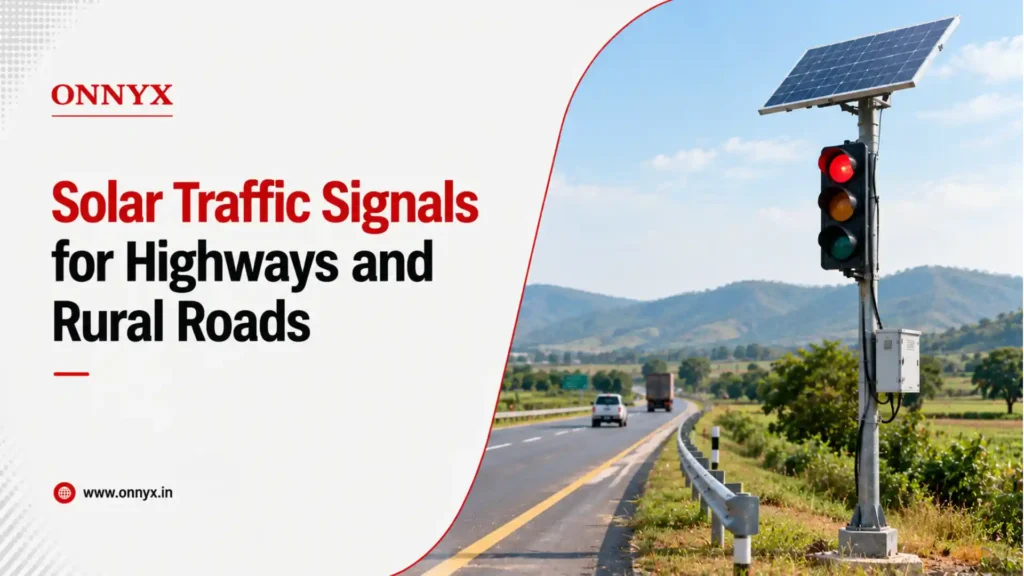
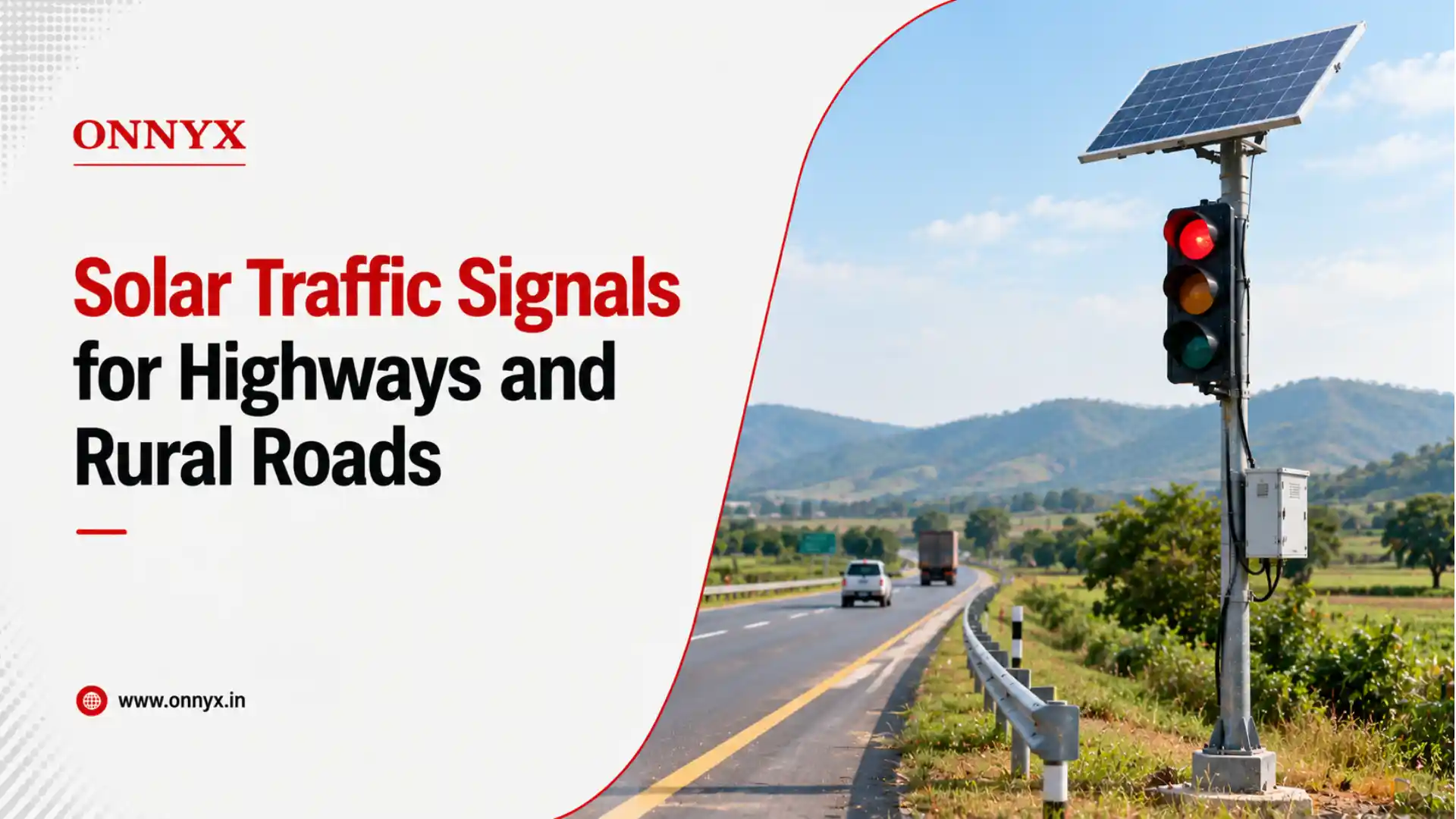
Solar Traffic Signals for Highways and Rural Roads
India’s rapid infrastructure development, particularly in its highway and rural road networks, necessitates advanced traffic control solutions. Conventional grid-powered signals face significant challenges in remote areas due to unreliable power supply and high installation costs.
Solar-powered traffic signals offer a sustainable and reliable alternative, addressing critical needs for power independence, reduced maintenance, and environmental alignment. ONNYX, as a leading solar traffic signal manufacturer, provides robust solutions tailored for India’s diverse geographical and infrastructural demands.
The Growing Need for Solar Traffic Solutions in India’s Highway and Rural Infrastructure
India is undergoing an unprecedented expansion of its road network; the national highway length increased from 91,287 km in FY2014 to 146,572 km by March 2026, representing a 61% growth, with four-lane highways seeing a 147% increase. This expansion, particularly into rural and remote areas, highlights the challenge of providing consistent power for traffic control.
Implementing conventional traffic signals in these regions is often hampered by the lack of grid connectivity, frequent power outages, and the prohibitive cost of extending electrical infrastructure. Solar-powered traffic signals overcome these limitations by offering self-sufficient, low-maintenance traffic management solutions. ONNYX, as a significant solar traffic light manufacturer, is instrumental in supporting these critical infrastructure projects.
Why Solar Traffic Signals Are Ideal for Highway and Rural Road Applications
Solar traffic signals are particularly well-suited for highway and rural applications due to their inherent energy independence and operational efficiency. They eliminate reliance on an often-unreliable electrical grid in remote areas.
- Energy Independence: Solar signals operate autonomously, drawing power from integrated solar panels and storing it in batteries, making them impervious to grid failures common in rural India.
- Lower Lifecycle Costs: While initial investment can be higher than conventional signals, solar systems incur minimal electricity costs and reduced infrastructure setup expenses, leading to significant long-term savings.
- Minimal Maintenance: Designed for remote deployment, these systems require less frequent and complex maintenance compared to grid-tied signals, which often need extensive electrical servicing.
- Environmental Benefits: Utilizing renewable solar energy, these signals align with India’s national goals for sustainable development and reduced carbon footprint in infrastructure projects.
Key Features of Solar-Powered Traffic Signal Systems for Highway Use
Effective solar-powered traffic signal systems for highways incorporate advanced features to ensure reliable and high-performance operation. These systems are engineered to withstand challenging environmental conditions and provide continuous service.
- High-Efficiency Solar Panels: Modern systems utilize high-efficiency mono/multicrystalline modules, typically in the 100–150 Wp range, capable of generating sufficient power even during periods of low sunlight or monsoon conditions as specified by industry leaders like ONNYX.
- Robust Battery Backup Systems: Quality systems are designed with battery autonomy ranging from 72 to 96 hours, with some government or critical-use specifications targeting up to 10 days of continuous operation without direct sunlight.
- Energy-Efficient LED Signal Lights: LED signal heads consume significantly less power, up to 90% less than conventional incandescent lamps, extending battery life and improving visibility in all weather conditions.
- Weatherproof and Vandal-Resistant Enclosures: Components are housed in IP65-rated, corrosion-resistant enclosures, ensuring durability and protection against harsh environmental factors prevalent in highway and rural settings.
Applications: Where Solar Traffic Signals Deliver Maximum Value
Solar traffic signals provide maximum value in specific scenarios where conventional solutions are impractical or cost-prohibitive. Their self-sufficiency makes them ideal for locations with limited existing infrastructure.
- National and State Highway Intersections: Critical for managing traffic flow at intersections lacking reliable grid connectivity, particularly in newly developed or upgraded sections of national highways. The National Highways Authority of India recently tendered for solar traffic signals on NH 66 in Kerala, demonstrating their adoption in major highway projects with an estimated value of ₹47,24,877.
- Rural Road Crossings: Essential for safety at remote rural crossings, agricultural routes, or intersections with seasonal traffic, where extending grid power is economically unfeasible. A project in Patan, Gujarat, for example, installed a wireless, solar-powered system for ₹31.92 lakh, featuring LED signal heads and pedestrian countdown timers as reported by Divya Bhaskar.
- Temporary Traffic Control: Highly effective for managing traffic during highway construction, maintenance, or widening projects, offering rapid deployment and easy relocation without the need for trenching. Solicitations from the Illinois Department of Transportation for portable solar traffic signal systems attest to this application with contract terms up to 10 years.
- School Zones and Pedestrian Crossings: Improves safety in villages and semi-urban areas along highways, providing controlled crossing points powered by renewable energy.
Installation and Maintenance Considerations for Highway Solar Traffic Systems
Successful deployment of solar traffic signals on highways requires careful planning and a structured approach to installation and ongoing maintenance. These considerations ensure optimal performance and longevity.
Site assessment is paramount for determining optimal solar panel orientation, accurately sizing the battery system, and ensuring signal visibility meets road safety standards. Foundations and pole installations must be robust enough to withstand highway wind loads and potential vehicle impacts. Routine maintenance, including cleaning solar panels and inspecting battery health, is crucial; for instance, battery replacement is typically required every 3-5 years, depending on the chemistry and climate per recent industry insights. Remote monitoring capabilities, offered by solutions from ONNYX, allow for proactive maintenance and fault detection in hard-to-reach locations, minimizing downtime and operational costs.
Comparison: Solar Traffic Signals vs. Conventional Grid-Powered Systems for Rural Applications
Choosing between solar and grid-powered traffic signals for rural applications involves a comprehensive evaluation of costs, reliability, and environmental impact. While grid-powered systems have lower upfront costs, solar solutions offer long-term operational advantages, especially where grid infrastructure is lacking or unreliable.
| Comparison Factor | Solar Traffic Signals | Grid-Powered Traffic Signals |
|---|---|---|
|
Initial Installation Cost (including infrastructure)
|
Higher initial investment, depending on system specifications and installation requirements, but generally avoids extensive trenching and electrical infrastructure.
|
Generally lower initial equipment costs where grid infrastructure is available, although grid extension and trenching can increase expenses in remote areas.
|
|
Operational Cost (5-year period)
|
Minimal electricity bills, but factor in battery replacement every 3-5 years. Overall lower than grid-powered.
|
Ongoing electricity utility bills; can be substantial in remote areas or during peak demand.
|
|
Reliability in Areas Without Grid Access
|
High; designed for autonomous operation with multi-day battery backup (e.g., 3-7 days autonomy) as stated by ONNYX, providing high power-outage resilience.
|
Low; entirely dependent on grid availability and susceptible to frequent power outages. Requires separate UPS or generator for backup.
|
|
Maintenance Frequency and Complexity
|
Lower routine maintenance, primarily panel cleaning and battery checks. Remote monitoring reduces truck rolls.
|
Higher; includes electrical system checks, utility bill management, and more frequent intervention during outages. Annual maintenance can range from $1,500 to $6,000 per intersection.
|
|
Environmental Impact and Sustainability
|
Zero carbon emissions during operation, aligns with renewable energy goals.
|
Dependent on the electricity grid’s energy source, which may include fossil fuels, contributing to emissions.
|
|
Suitability for Remote Highway Intersections
|
Ideal; eliminates the need for expensive grid infrastructure and ensures continuous operation where power is unreliable or unavailable.
|
Poor; requires significant investment in grid extension, making it impractical for many remote locations.
|
How ONNYX Supports Highway Authorities with Solar Traffic Signal Solutions
ONNYX Electronisys is a trusted partner for highway authorities, providing specialized solar traffic signal solutions designed for the challenging conditions of Indian highways and rural roads. Our product range is engineered for reliability, efficiency, and compliance with national standards.
ONNYX offers solar traffic signals with high-efficiency solar panels, advanced charge controllers, and robust battery backup systems, typically providing 72-96 hours of autonomy to ensure uninterrupted operation during extended cloudy periods or power outages as detailed in our technical specifications. Our systems incorporate ultra-bright LED signal lights for maximum visibility and durable, weatherproof enclosures built to withstand harsh environments. All ONNYX solutions adhere to relevant IRC standards, such as IRC:93-1985 for traffic signal design and installation, and applicable BIS certifications for solar and LED components, ensuring regulatory compliance and performance. We have successfully implemented solar traffic signal installations on state and national highways, demonstrating our capability to deliver reliable traffic control solutions in diverse geographical settings. Explore Learn more.
Key Takeaways
- India’s highway expansion, particularly into rural areas, necessitates reliable and cost-effective traffic control solutions where grid power is often unavailable.
- Solar traffic signals offer energy independence, lower lifecycle costs, and reduced maintenance, making them ideal for remote highway and rural road applications.
- Modern systems feature high-efficiency solar panels, multi-day battery backup (72-96 hours), and energy-efficient LED signals for continuous operation.
- Solar signals are crucial for national highway intersections without grid connectivity, rural road crossings, and temporary traffic control during construction.
- While initial costs may be higher, solar signals often yield significant long-term savings compared to grid-powered systems due to zero electricity bills and lower operational overhead.
- ONNYX provides IRC and BIS compliant solar traffic signal solutions, designed to meet the specific requirements of Indian highway authorities.
Conclusion: Building Safer Highway and Rural Road Networks with Solar Traffic Technology
The imperative to enhance road safety and manage traffic efficiently across India’s expanding highway and rural road networks is undeniable. Solar traffic signals emerge as a pragmatic and sustainable solution, enabling traffic control in locations previously deemed unserviceable due to power constraints.
By offering energy independence, significant long-term cost savings, and enhanced reliability, solar traffic signals directly address the critical needs of state and national highway authorities. ONNYX remains committed to supporting India’s infrastructure modernization by providing cutting-edge solar traffic solutions that are robust, compliant, and tailored for diverse operational environments. Highway authorities are encouraged to explore the implementation of solar traffic signals to build safer, smarter, and more connected road networks.
Key Terms Glossary
Solar Traffic Signal: A traffic control device powered by solar panels and a battery system, operating independently of the electrical grid.
Autonomy: The duration a solar traffic signal can operate continuously using only its stored battery power, typically measured in hours or days, without direct sunlight.
LED Signal Head: The light-emitting diode component of a traffic signal, known for its low power consumption and high visibility.
Battery Backup System: A component of a solar traffic signal that stores energy from solar panels to power the system during periods of low sunlight or at night.
IRC Standards: Guidelines from the Indian Roads Congress that dictate the design, installation, and operational parameters for road traffic signals in India.
BIS Certifications: Product quality and safety standards set by the Bureau of Indian Standards, applicable to various components of solar traffic signals like solar panels and LED lights.
Off-Grid Location: A site or area that is not connected to the main electrical power grid, making solar-powered solutions essential.
Lifecycle Cost: The total cost of a traffic signal system over its entire operational life, including initial purchase, installation, energy, and maintenance expenses.
FAQs
Q1. What are solar traffic signals and how do they work on highways?
Solar traffic signals are autonomous traffic control systems powered by photovoltaic panels that convert sunlight into electricity. This energy charges a battery bank, which then powers LED signal lights and the traffic controller, allowing them to operate independently of the electrical grid, making them ideal for remote highway intersections.
Q2. How long do solar traffic signals operate without sunlight during monsoon season?
Quality solar traffic signals are typically designed to operate for 72-96 hours (3-4 days) without direct sunlight, with some advanced systems offering up to 5-7 days of autonomy. This extended backup is crucial for reliable operation during prolonged cloudy periods or monsoon seasons in India, ensuring continuous traffic management.
Q3. What is the cost difference between solar and grid-powered traffic signals for rural roads?
Solar traffic signals generally require a higher initial investment than conventional grid-powered systems. However, they can reduce ongoing electricity expenses and avoid costly grid extensions in remote rural locations. The overall cost-effectiveness depends on installation requirements, local electricity tariffs, battery replacement cycles, and maintenance expenses over the system’s lifecycle.
Q4. Are solar traffic signals reliable enough for high-speed national highway intersections?
Yes, properly designed solar traffic signals are highly reliable for high-speed national highway intersections. They feature robust battery backup systems, high-visibility LED signal heads, weatherproof construction, and are engineered to comply with IRC highway standards, ensuring consistent performance and safety comparable to grid-powered systems. Explore Learn more.
Q5. What maintenance is required for solar traffic signals on highways?
Routine maintenance for solar traffic signals on highways primarily involves cleaning solar panels to ensure optimal energy capture, inspecting battery health for longevity, checking LED functionality for visibility, and verifying controller operations. These tasks are typically performed quarterly or semi-annually, making maintenance simpler and less frequent than grid-powered systems in remote locations.