
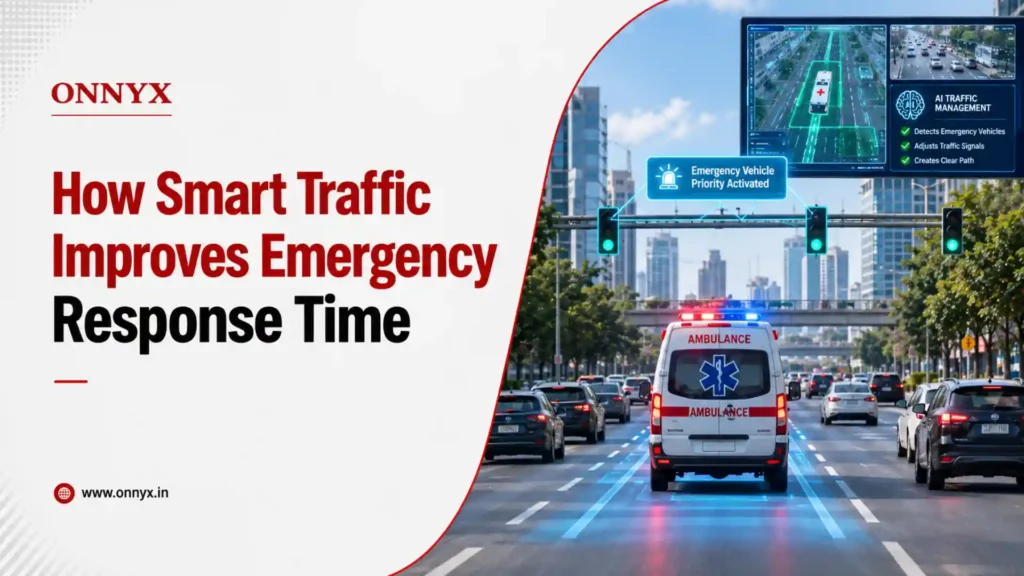
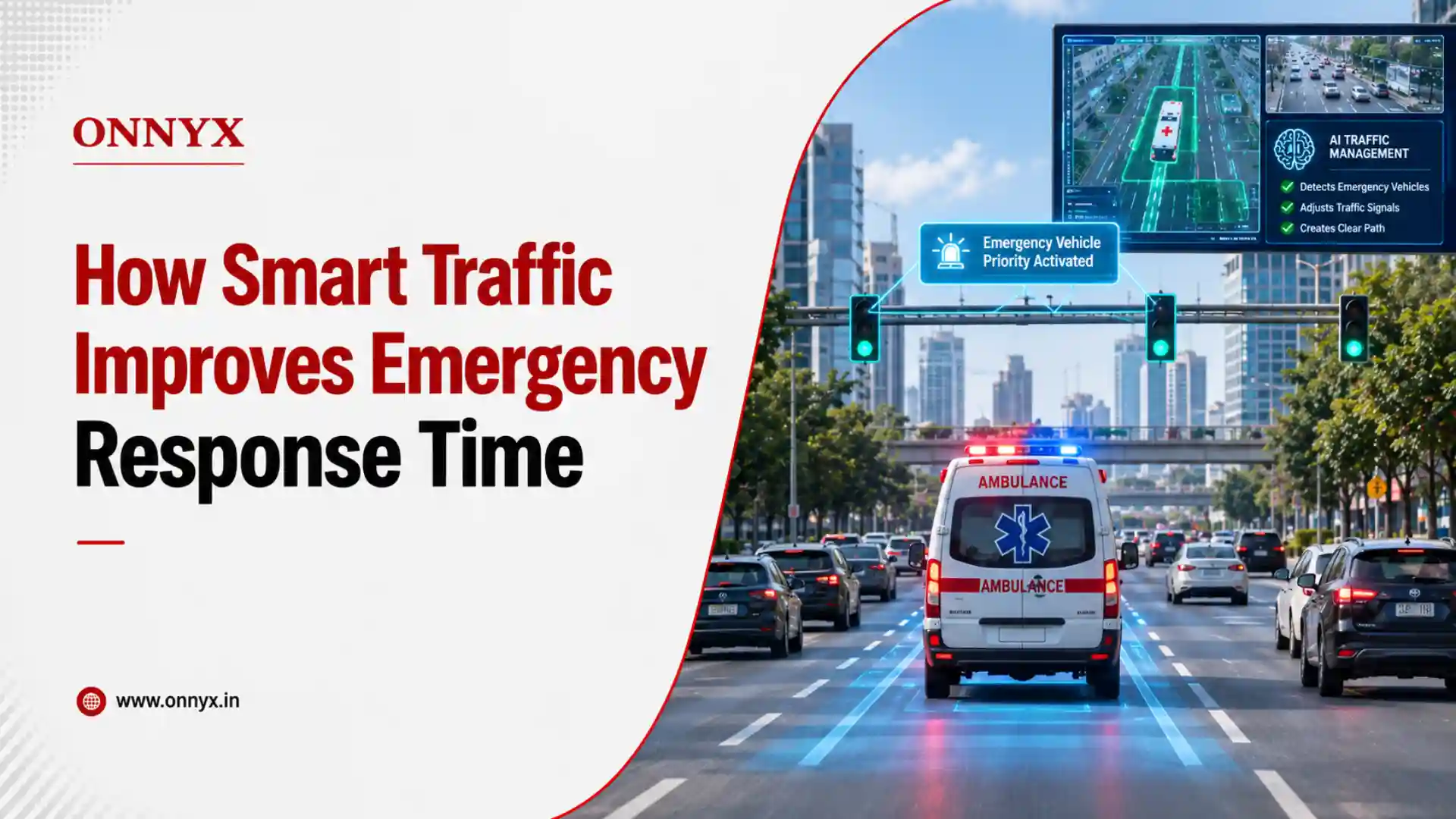
How Smart Traffic Improves Emergency Response Time
Traffic congestion poses a significant challenge to urban emergency services, directly impacting response times for ambulances, fire services, and police. These delays can have severe consequences, from increased mortality rates in medical emergencies to greater property damage in fires. Modernizing urban infrastructure with smart traffic solutions offers a critical pathway to enhancing public safety and operational efficiency for first responders.
Government initiatives, particularly in India’s Smart Cities Mission, increasingly emphasize the integration of advanced traffic technologies to optimize emergency response and build more resilient urban environments.
What Is Smart Traffic Infrastructure for Emergency Response?
Smart traffic infrastructure for emergency response refers to advanced Intelligent Transport Systems (ITS) specifically engineered to prioritize emergency vehicles through urban road networks. These systems aim to create unimpeded pathways, ensuring rapid transit during critical incidents.
Core technologies include emergency vehicle preemption (EVP), adaptive signal control, and real-time traffic monitoring, all integrated within a centralized traffic management center.
- Emergency Vehicle Preemption (EVP): A technology that detects approaching emergency vehicles and automatically adjusts traffic signals to grant them a green light.
- Adaptive Signal Control: Systems that dynamically alter traffic light timings based on real-time traffic flow and incident data, including emergency vehicle presence.
- Real-Time Monitoring: Utilizes sensors, cameras, and IoT devices to provide continuous data on road conditions, congestion levels, and emergency vehicle locations.
These systems detect and prioritize emergency vehicles by communicating directly with traffic signals or a central control system, facilitating a “green corridor” that minimizes stops and delays. Integration with traffic management centers and command control systems allows for comprehensive oversight and coordinated response.
Key Technologies That Enable Faster Emergency Response
Several advanced technologies converge to create a seamless and expedited emergency response environment. These innovations move beyond traditional traffic management to actively clear paths for first responders.
Onnyx Electronisys provides intelligent traffic management solutions for emergency vehicle prioritization and urban mobility.
- Emergency Vehicle Preemption (EVP) Systems: These systems automatically create green corridors for emergency vehicles by detecting their approach and altering signal phases. Field deployments of sound-activated EVP have reduced emergency response times by 14% to 23% in areas like Southwestern Pennsylvania.
- GPS-Based Vehicle Tracking and Route Optimization: Real-time GPS tracking allows emergency dispatchers to monitor vehicle locations with pinpoint accuracy and dynamically adjust routes to avoid congestion or incidents. A smart route optimization study reported 35% faster response times and 25% less fuel use in simulation.
- AI-Powered Traffic Signal Adaptation: Artificial intelligence analyzes live traffic data from sensors and cameras to predict congestion and adjust signal timings dynamically, facilitating smoother flow for emergency vehicles. A real-time AI-assisted signal control system in San Anselmo reduced time spent in traffic by about 30%.
- Vehicle-to-Infrastructure (V2I) Communication: This technology allows emergency vehicles to communicate directly with roadside infrastructure, such as traffic signals, to request priority. India’s 2026 policy discussions favor a phased, hybrid deployment strategy combining C-V2X network-based communication for scalability and direct C-V2X for low-latency safety applications.
These technologies collectively enhance operational efficiency and public safety by ensuring emergency vehicles navigate urban landscapes with minimal hindrance.
Measurable Impact: How Much Time Smart Infrastructure Saves
The implementation of smart traffic infrastructure translates directly into quantifiable reductions in emergency response times, which has profound implications for public safety. Data consistently demonstrates significant improvements, measured in both percentages and minutes. Explore Learn more.
The “Golden Hour Framework” highlights the critical impact of these time savings: for every minute saved in cardiac emergency response, survival rates increase by 7% to 10%. Similarly, Faster fire service response can help reduce the extent of property damage. This framework quantifies the exact value proposition of smart traffic infrastructure in terms traffic authorities and city planners understand: lives saved and costs avoided per intersection upgraded.
Industry data shows that response times can be reduced by 14% to 23% with smart traffic systems, with some corridor studies reporting even greater gains. Chennai, for example, saw its average ambulance response time improve from 7.45 minutes in 2023–24 to 6.14 minutes in 2026–27 (till April), demonstrating the tangible benefits of optimized systems.
Other Indian cities have also reported notable improvements: Rajkot reduced ambulance response times from 13 minutes to 10 minutes using GPS-integrated traffic signals, and Trichy saw an improvement from 11 minutes 26 seconds to 9 minutes 48 seconds through hotspot-based placement strategies. These examples underscore the direct correlation between advanced traffic technologies and improved emergency outcomes.
Capability | Traditional Traffic Systems | Smart Traffic Infrastructure | Impact on Response Time |
Emergency vehicle detection method | Manual observation, radio calls, sirens | GPS tracking, V2I communication, acoustic sensors, AI-based video analytics | Instantaneous detection, proactive signal changes |
Signal priority mechanism | Manual signal override by police, fixed timing cycles | Automated Emergency Vehicle Preemption (EVP), adaptive signal control | Creates green corridors, eliminates stops at intersections |
Route optimization capability | Driver’s knowledge, static maps | Real-time GPS routing with live traffic data, AI-powered predictive analytics | Optimized routes avoiding congestion, dynamic rerouting |
Real-time coordination with traffic center | Limited or reactive communication | Integrated Command and Control Centers (ICCCs) with live data feeds | Centralized oversight, coordinated response across agencies |
Integration with emergency dispatch systems | Voice communication, separate systems | Seamless data exchange, automated priority signaling | Faster dispatch, direct communication between dispatch and traffic signals |
Average time saved per emergency call | Minimal or none due to congestion | 14-23% reduction in response times | Directly contributes to saving lives and reducing damage |
Implementation Considerations for Traffic Authorities
Deploying smart traffic systems for emergency response requires careful planning and coordination among various municipal departments. Successful implementation hinges on addressing technical, operational, and financial aspects.
Onnyx Electronisys supports implementation, integration, and maintenance of emergency traffic management systems.
- Technical Requirements: This includes upgrading existing traffic signal controllers to be compatible with intelligent traffic systems, installing vehicle detection sensors, and establishing robust communication networks (fiber, wireless). Modern solutions often leverage cloud-based platforms for scalability and real-time data processing.
- Integration with Existing Infrastructure: New systems must seamlessly integrate with legacy traffic signal infrastructure and the Integrated Command & Control Center (ICCC) systems already operational in many smart cities. This ensures a unified operational picture and avoids siloed technologies.
- Training and Coordination: Traffic police, emergency service personnel, and traffic management center operators require comprehensive training on the new systems. This includes understanding system functionalities, override procedures, and inter-agency communication protocols for effective incident management.
- Budget and ROI: While initial investments can be substantial, the return on investment (ROI) for smart traffic solutions is compelling. A cloud-based vehicle preemption program projected over $176 million in benefits over 15 years, with a Benefit-Cost Ratio (BCR) of 3.07, primarily from reduced emergency response fatalities and transit rider time savings.
These considerations are crucial for ensuring that smart traffic investments lead to tangible improvements in public safety and operational efficiency.
ONNYX Emergency Vehicle Preemption Solutions
ONNYX is at the forefront of delivering intelligent traffic systems that enable robust emergency vehicle prioritization, directly contributing to public safety enhancement and smart urban development. Our solutions are designed to address the unique challenges of urban mobility in India.
Our emergency vehicle preemption (EVP) systems are built on advanced AI-powered traffic management and real-time monitoring capabilities, ensuring that emergency vehicles receive priority at critical intersections.
- Intelligent Traffic Systems: ONNYX leverages AI and video analytics for precise vehicle detection and adaptive traffic control, optimizing traffic flow not just for emergency vehicles, but for overall congestion management.
- Real-Time Monitoring and Adaptive Control: ONNYX’s solutions provide traffic management centers with live data, allowing for immediate signal adjustments and route optimization to clear paths for first responders. This real-time intelligence is crucial for effective incident detection and response.
- Integration Capabilities: ONNYX solutions are designed for seamless integration with existing traffic signal infrastructure, Integrated Command and Control Centers (ICCCs), and emergency dispatch systems. This ensures a unified ecosystem for urban traffic control.
Deployments are designed to help agencies improve emergency response efficiency and significant reductions in emergency response times, enhancing our partners’ ability to meet and exceed National Health Mission benchmarks of 20 minutes for urban areas. ONNYX’s focus on innovation, reliability, and public safety makes ONNYX a technology provider for modernizing city infrastructure. Explore Learn more.
Conclusion: Building Safer Cities Through Smart Traffic Technology
The integration of smart traffic technology represents a paradigm shift in how urban areas manage emergency response. By leveraging intelligent transport systems, cities can significantly reduce emergency vehicle response times, directly impacting outcomes for medical emergencies, fire incidents, and law enforcement situations.
Traffic authorities and smart city planners have a critical role in championing the adoption of these advanced traffic technologies. Modernizing emergency response capabilities through smart infrastructure is not merely an upgrade; it is an essential investment in public safety and the resilience of urban communities.
For cities evaluating their current emergency response infrastructure, assessing gaps and exploring proven smart traffic solutions, including solutions from providers such as ONNYX Electronisys, is the vital next step towards building safer, smarter, and more efficient urban environments.
Key Takeaways
- Smart traffic infrastructure significantly reduces emergency response times, improving outcomes for critical incidents.
- Emergency Vehicle Preemption (EVP) and AI-powered adaptive signal control create green corridors for first responders.
- Indian cities like Chennai, Rajkot, and Trichy have demonstrated measurable reductions in ambulance response times using smart traffic solutions.
- The “Golden Hour Framework” highlights that each minute saved in emergency response directly translates to increased survival rates and reduced property damage.
- Successful implementation requires careful consideration of technical integration, training, and a clear understanding of ROI.
- ONNYX Electronisys offers comprehensive solutions for emergency vehicle prioritization, integrating advanced traffic technologies into existing urban infrastructure.
Key Terms Glossary
Intelligent Transport Systems (ITS): Advanced applications that aim to provide innovative services relating to different modes of transport and traffic management, enabling users to be better informed and make safer, more coordinated, and ‘smarter’ use of transport networks.
Emergency Vehicle Preemption (EVP): A technology that grants priority to emergency vehicles at signalized intersections by detecting their approach and temporarily altering traffic signal phases to provide a green light.
Adaptive Signal Control: A traffic management strategy where signal timings are continuously adjusted in real-time based on current traffic conditions, vehicle demand, and incident information.
Vehicle-to-Infrastructure (V2I) Communication: A system that allows vehicles to communicate wirelessly with roadside infrastructure, such as traffic signals and sensors, to exchange critical information for safety and traffic efficiency.
Integrated Command and Control Center (ICCC): A centralized facility in smart cities that integrates data from various urban systems, including traffic management, surveillance, and emergency services, for comprehensive monitoring and coordinated response.
Golden Hour Framework: A data-driven concept emphasizing that the first 60 minutes following a traumatic injury or medical emergency are the most critical for survival, directly linking faster response times to improved patient outcomes.
FAQs
Q1. How much faster can emergency vehicles respond with smart traffic systems?
Emergency vehicles can respond significantly faster with smart traffic systems, typically seeing in response times. Some deployments have achieved even higher gains, with an IoT-based emergency vehicle alert system reporting an average response time.
Q2. What is emergency vehicle preemption and how does it work?
Emergency Vehicle Preemption (EVP) is a technology that detects approaching emergency vehicles and automatically changes traffic signals to grant them a green light, creating a clear path. It typically uses GPS-based vehicle tracking and/or acoustic sensors for detection, communicating with traffic signal controllers to prioritize emergency passage.
Q3. Which Indian cities have implemented smart traffic for emergency response?
Several Indian cities have implemented smart traffic for emergency response as part of their Smart Cities Mission initiatives. Notable examples include Chennai, which reduced ambulance response times to 6.14 minutes, and Rajkot and Trichy, which have also reported significant improvements through GPS-integrated signals and hotspot strategies, as highlighted in a 2025 research paper on Indian smart-city emergency frameworks. Explore Learn more.
Q4. How much does it cost to install emergency vehicle preemption systems?
The cost to install emergency vehicle preemption systems varies based on scale and existing infrastructure, but a cloud-based vehicle preemption program estimated deployment costs for a large-scale project. However, the ROI often justifies the investment, with benefit-cost ratios exceeding 3:1 in many cases.
Q5. Can smart traffic systems work with existing traffic signals?
Yes, smart traffic systems are often designed to work with existing traffic signals. Many solutions, including those from ONNYX, offer retrofit capabilities and integration requirements with legacy infrastructure, allowing cities to upgrade their current systems rather than replacing them entirely.