
Urban congestion continues to be a major drain on economic productivity and environmental health, with traditional fixed-timing signals often exacerbating the problem. These legacy systems are notorious for inefficiently managing traffic flow, leading to significant delays and increased emissions. Artificial intelligence (AI) powered traffic signal control offers a transformative solution, moving beyond reactive adjustments to proactive, predictive traffic management that optimizes urban mobility in real-time.
This paradigm shift leverages machine learning to dynamically adjust signal timings based on actual, evolving traffic patterns, providing cities with the tools to significantly alleviate congestion and improve urban living.
Why Traditional Traffic Signals Are Failing Modern Cities
Traditional fixed-timing traffic signals, relying on historical averages and static plans, are inherently ill-equipped to handle the dynamic and unpredictable nature of modern urban traffic. This outdated approach contributes significantly to congestion, wasting an estimated 20-30% of urban travel time.
Such inefficiencies lead to widespread frustration, increased fuel consumption, and higher carbon emissions, highlighting the urgent need for more intelligent solutions.
- Fixed-timing signals cannot adapt to real-time fluctuations in traffic volume, incidents, or special events.
- They often create unnecessary stops and delays, even when cross-traffic is minimal.
- The manual process of retiming these signals is costly, time-consuming, and prone to human error, failing to keep pace with rapid urban development.
How AI-Powered Traffic Signal Control Works
AI-powered traffic signal control systems operate by continuously analyzing real-time data to make intelligent, dynamic adjustments to signal timings. This capability represents a significant leap from the static or pre-programmed responses of older systems. The core technologies underpinning these systems are computer vision, edge computing, and advanced reinforcement learning algorithms.
These components work in concert to process vast amounts of data and predict traffic behavior with remarkable accuracy.
- Real-time data is collected from a diverse array of sources, including high-resolution cameras, in-ground sensors, and increasingly, connected vehicle feeds.
- Edge computing processes this data directly at the intersection, minimizing latency and enabling immediate decision-making.
- Reinforcement learning algorithms learn from observed traffic patterns and their own actions, continuously refining signal timing strategies to optimize flow and reduce congestion.
The study demonstrated measurable reductions in travel time and improved traffic flow, highlighting the operational efficiency that AI-powered traffic signal control can deliver.
The 4-Stage Intelligence Framework for Traffic Signal AI
Implementing AI for traffic signal control involves a progressive journey through distinct stages, each building upon the last to enhance system intelligence and responsiveness. This framework provides a structured approach for cities to understand and deploy advanced traffic management solutions, moving beyond basic automation to truly predictive and adaptive control.
This phased progression ensures a robust and scalable implementation of AI in urban mobility.
Stage 1: Data Collection – Multi-Modal Sensor Fusion and Vehicle Detection
The foundational stage involves comprehensive data acquisition from various sources. Modern systems move beyond simple loop detectors to integrate multi-modal data streams for a richer understanding of traffic. Computer vision systems, for instance, can achieve vehicle detection recall of 97.9% and classification accuracy of 99.03%.
- High-resolution cameras provide visual data for vehicle classification, counting, and queue length estimation.
- Lidar and radar sensors offer precise speed, position, and trajectory data, especially effective in adverse weather conditions.
- Acoustic sensors detect vehicle types and volumes, complementing visual and radar data.
- Connected vehicle (V2X) communication provides granular, anonymized data on individual vehicle movements and intentions.
Stage 2: Pattern Recognition – ML Models Identifying Congestion Triggers and Flow Anomalies
Once data is collected, machine learning models analyze these inputs to identify recurring traffic patterns, anomalies, and potential congestion triggers. This stage moves beyond simple detection to understanding the dynamics of traffic flow. Algorithms learn to distinguish between typical rush-hour patterns and unusual events like accidents or sudden surges in demand.
- Supervised learning models classify traffic states (e.g., free-flow, moderate, congested) based on historical and real-time data.
- Unsupervised learning identifies novel patterns or outliers that might indicate incidents or unexpected demand shifts.
- Deep learning architectures, particularly convolutional neural networks (CNNs) and recurrent neural networks (RNNs), process spatio-temporal data to understand complex traffic behaviors across intersections.
Stage 3: Predictive Optimization – Forecasting Traffic Demand 5-15 Minutes Ahead
With robust pattern recognition, AI systems can begin to forecast traffic demand in the immediate future, typically 5 to 15 minutes ahead. This predictive capability is crucial for proactive traffic management. By anticipating demand, signals can be adjusted before congestion fully materializes, preventing bottlenecks. Reinforcement learning algorithms are particularly effective here, as they learn optimal strategies through trial and error in simulated environments.
- Time-series forecasting models, like Long Short-Term Memory (LSTM) networks, predict future traffic volumes and speeds based on recent trends.
- Graph neural networks (GNNs) analyze the interconnectedness of the road network to predict how changes at one intersection will propagate.
- Reinforcement learning agents, such as those using Proximal Policy Optimization (PPO), explore various signal timing strategies to maximize flow and minimize delay under predicted conditions.
Stage 4: Adaptive Response – Microsecond-Level Signal Timing Adjustments Across Networked Intersections
The final stage involves the real-time implementation of optimized signal timings. This is where the AI system translates its predictions and learned strategies into actionable signal changes. Adaptive response systems can make microsecond-level adjustments, coordinating across multiple networked intersections to maintain optimal flow. This level of responsiveness far exceeds human capabilities.
- The AI controller communicates directly with traffic signal cabinets, overriding fixed plans with dynamic timing.
- Networked intersections coordinate their phases to create “green waves” that minimize stops and reduce travel time across corridors.
- The system continuously monitors the impact of its adjustments, feeding new data back into Stage 1 for ongoing learning and refinement, forming a closed-loop optimization cycle.
Measurable Benefits: What Cities Are Actually Achieving
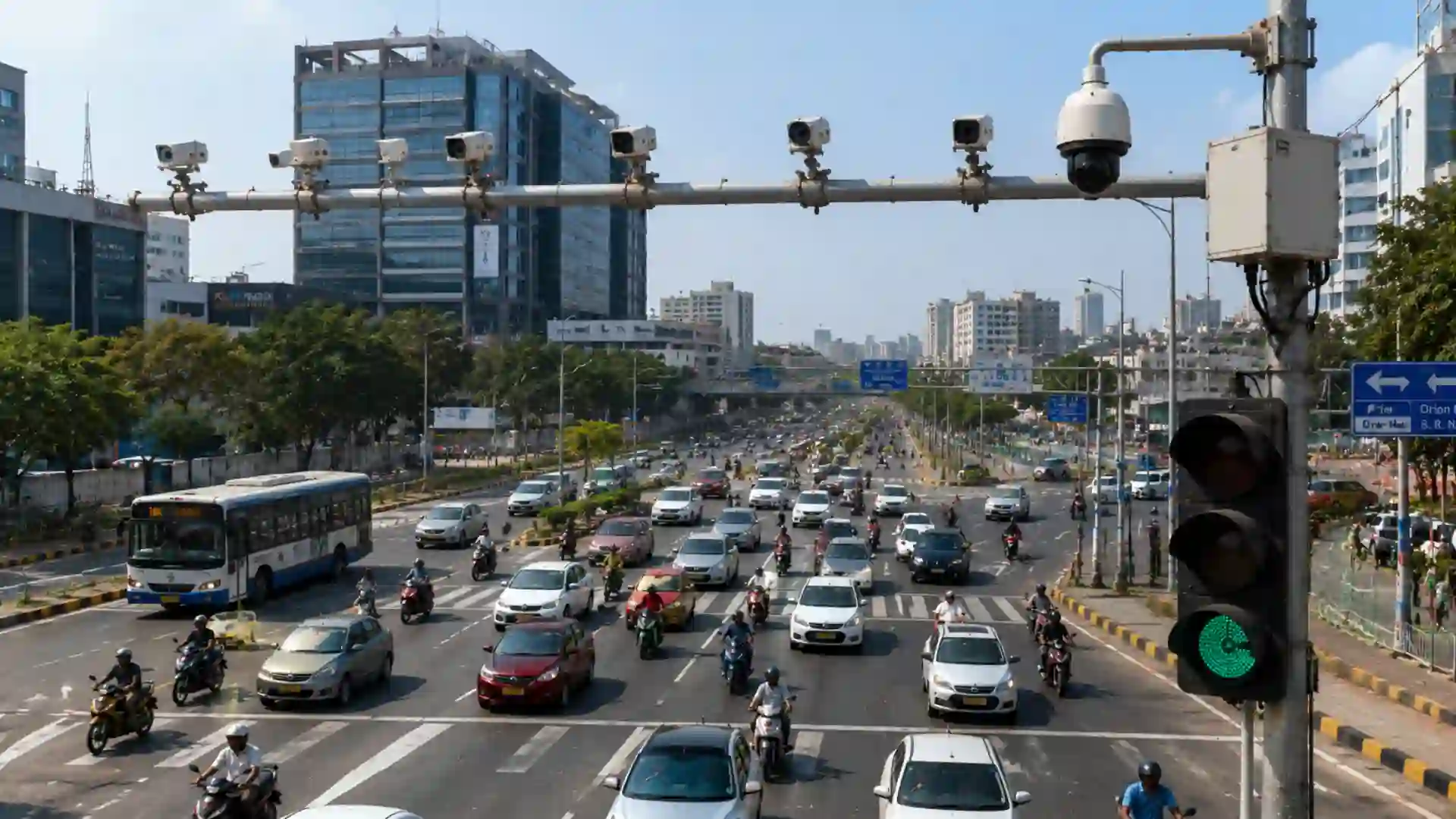
Cities deploying AI-powered traffic signal control are realizing significant, quantifiable benefits across multiple fronts, demonstrating a clear return on investment. These improvements extend beyond mere traffic flow to encompass environmental and public safety gains. One simulation study from Toronto, Canada, found that an AI-enabled signal control method reduced total time spent by ~19% compared to the city’s signal plan.
Travel Time Reductions: 15-25% in Pilot Deployments
AI systems consistently deliver substantial reductions in vehicle travel times. San Anselmo, California, for example, achieved approximately 30% less time in traffic with an AI-assisted system. A 2025 review of AI-enabled adaptive traffic control systems reported reductions of 24% to 36% in average vehicle delay and up to 19% in overall travel time. Explore Learn more.
Emission Reductions of 20-35% Through Reduced Idling and Stop-and-Go Patterns
By smoothing traffic flow and minimizing idling, AI-powered signals lead to significant cuts in vehicle emissions. A 2025 study of 100 Chinese cities estimated a 6.65% reduction in CO₂ emissions, totaling 31.73 million tonnes annually, through big-data empowered adaptive traffic signals. On a demonstration route within that study, CO₂ emissions fell by 16%, primarily by reducing idling and braking times. An AI-driven traffic signal control simulation study showed cumulative CO₂ emissions falling by 18%, while maintaining pedestrian service levels.
Emergency Vehicle Priority Routing Cutting Response Times by 20-40%
AI systems can prioritize emergency vehicles, creating dynamic green waves along their routes. This capability dramatically reduces response times, which can be critical for saving lives. A 2025 study reported a system that improved emergency response time by 30-40% during peak traffic and about 20% off-peak, significantly enhancing public safety. Another study found emergency vehicle travel time shortened by up to 62.85% in simulation, versus a benchmark method.
Operational Benefits and Long-Term Value
AI-powered traffic signal control delivers long-term operational value by improving traffic flow, reducing congestion, enhancing road safety, and supporting more efficient use of transportation infrastructure. The overall implementation approach depends on factors such as city size, existing infrastructure, traffic volume, communication networks, technology requirements, and deployment objectives. Many cities begin with pilot intersections or priority corridors before expanding to larger deployments based on operational outcomes and future mobility requirements. Continuous monitoring, analytics, and system optimization help maximize the long-term effectiveness of intelligent traffic management solutions.
This comparison table breaks down the key operational, performance, and cost differences between legacy fixed-timing traffic signals and modern AI-powered adaptive systems, helping cities evaluate upgrade decisions.
Feature/Metric | Traditional Fixed-Timing | AI-Powered Adaptive | Advantage |
Signal timing adjustment method | Pre-programmed, time-of-day plans | Real-time, dynamic ML-driven optimization | AI-Powered Adaptive |
Response to traffic pattern changes | Static; slow to adapt to changes | Instantaneous; predictive and reactive | AI-Powered Adaptive |
Average travel time reduction | Minimal or none | 15-25% in pilot deployments | AI-Powered Adaptive |
Implementation Requirements | Basic signal hardware and fixed-time controllers | Advanced sensors, AI software, intelligent controllers, communication networks, and analytics platform | AI-Powered Adaptive |
Ongoing maintenance requirements | Periodic manual inspections, hardware maintenance, and signal retiming | Continuous software updates, AI model optimization, sensor calibration, preventive maintenance, and system monitoring | AI-Powered Adaptive |
Emergency vehicle accommodation | Basic preemption (often disruptive) | Dynamic green waves, route optimization | AI-Powered Adaptive |
Data collection capabilities | Limited (loop detectors, manual counts) | Extensive (cameras, radar, V2X, analytics) | AI-Powered Adaptive |
Implementation Challenges and Real-World Solutions
While the benefits of AI-powered traffic signals are compelling, cities face several challenges during implementation. Addressing these proactively is key to successful deployment and long-term operational efficiency. These challenges range from infrastructure compatibility to data security and operational consistency.
Effective solutions often involve phased rollouts, robust data governance, and strategic integration planning.
- Infrastructure Requirements: Many existing signal cabinets and controllers are legacy systems, requiring significant upgrades or full replacement to support AI hardware and software. Solutions involve vendor partnerships that offer modular upgrades compatible with existing infrastructure, or a staged replacement plan.
- Data Privacy Concerns: Camera-based detection raises privacy concerns. Anonymization techniques, such as on-device processing that extracts only aggregate traffic data (counts, speeds) without storing identifiable images or videos, are crucial.
- Handling Edge Cases: Construction zones, special events, and system failures can disrupt AI models. Solutions include integrating real-time event feeds, developing robust fallback mechanisms (e.g., reverting to optimized fixed timings during outages), and continuous model retraining.
- Integration with Legacy Systems: AI solutions must seamlessly integrate with existing city-wide traffic management platforms and emergency services. This often requires open APIs and standardized data protocols to ensure interoperability and avoid creating new data silos.
A 2026 survey on AI-based adaptive traffic signal control concluded that large-scale deployment remains challenging due to infrastructure modernization requirements, system integration complexity, interoperability with legacy traffic systems, and operational planning considerations.
Conclusion: The Road Ahead for AI Traffic Signals
AI-powered traffic signal control is transforming urban mobility, offering a path to significantly reduce congestion, emissions, and response times for emergency services. The evolution from static timing to dynamic, predictive optimization represents a fundamental shift in traffic management philosophy. As cities continue to grow, these intelligent systems will become indispensable tools for creating more efficient, sustainable, and safer urban environments.
Looking forward, the convergence of AI with Vehicle-to-Everything (V2X) communication and autonomous vehicle ecosystems will unlock even greater potential. Predictive capabilities are expected to extend to 30-minute forecasting windows by 2027-2028, enabling even more proactive network-wide optimization. Cities should initiate corridor-level pilots to validate benefits and build institutional knowledge before pursuing network-wide deployments.
Key Takeaways
- AI traffic signals move beyond reactive adjustments to proactive, predictive management, reducing urban travel time waste.
- The 4-Stage Intelligence Framework guides deployment from data collection to adaptive response.
- Pilot programs demonstrate 15-25% travel time reductions and 20-35% emission cuts.
- Emergency vehicle response times can be improved by 20-40% using AI prioritization.
- Implementation requires addressing infrastructure compatibility, data privacy, and integration with legacy systems.
- Future AI systems will integrate more deeply with V2X and autonomous vehicles for enhanced predictive capabilities.
Key Terms Glossary
Adaptive Traffic Signals: Traffic signals that adjust their timing based on real-time traffic conditions and pre-defined rules.
Reinforcement Learning (RL): A type of machine learning where an agent learns to make optimal decisions by performing actions in an environment and receiving rewards or penalties.
Computer Vision: A field of artificial intelligence that enables computers to interpret and understand visual information from the real world.
Edge Computing: A distributed computing paradigm that brings computation and data storage closer to the sources of data, such as traffic intersections.
V2X Communication: Vehicle-to-Everything communication, which allows vehicles to exchange information with other vehicles (V2V), infrastructure (V2I), pedestrians (V2P), and the network (V2N).
Green Wave: A coordinated sequence of traffic signals that allows a continuous flow of traffic over several intersections without stopping.
Anonymization Techniques: Methods used to remove or obscure personally identifiable information from data, ensuring privacy while allowing data analysis.
Legacy Infrastructure: Older, existing physical and technological systems that may require upgrades or replacement to integrate with newer technologies.