
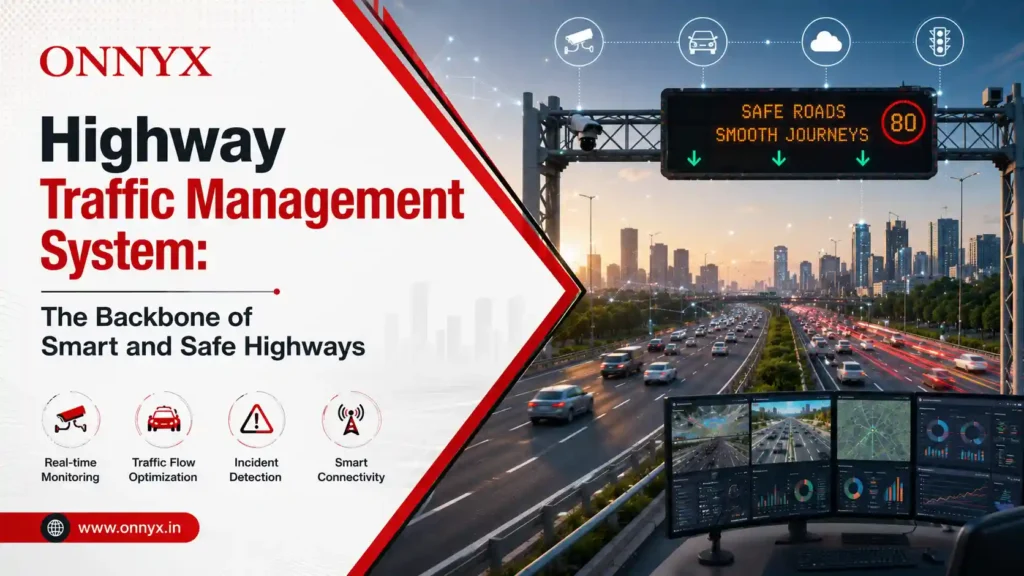
Highway Traffic Management System: The Backbone of Smart and Safe Highways
Every day, millions of vehicles navigate highways across India and the world and every day, those highways become more congested, more dangerous, and more inefficient. From multi-vehicle pile-ups on expressways to chronic bottlenecks at toll plazas, the cost of poorly managed highway traffic is enormous: in lost productivity, in lives, and in environmental damage.
The traditional approach of deploying traffic police, erecting static signs, and reacting to incidents after the fact is simply no longer sufficient. As vehicle volumes surge and infrastructure ages, the need for intelligent, data-driven, proactive solutions has never been more urgent.
This is where a Highway Traffic Management System (HTMS) steps in a transformative technology stack that brings intelligence, automation, and real-time responsiveness to highway operations.
What is a highway traffic management system?
A Highway Traffic Management System is an integrated framework of technologies, infrastructure, and operational protocols designed to monitor, manage, and optimise traffic flow across highway networks. It forms a critical component of Intelligent Transportation Systems (ITS) the broader ecosystem of smart mobility solutions adopted by governments and infrastructure operators worldwide.
At its core, a highway traffic management system leverages AI traffic management algorithms, IoT-connected sensors, high-resolution cameras, and real-time data analytics to give traffic authorities unprecedented visibility and control over road conditions. Rather than waiting for problems to escalate, an intelligent traffic management system enables operators to predict, prevent, and respond to incidents before they spiral into major disruptions.
From detecting a stalled vehicle within seconds to dynamically rerouting thousands of cars away from an accident zone the HTMS is the digital nerve centre of the modern highway.
Key Components of a Highway Traffic Management System
CCTV & AI-Based Surveillance
High-definition CCTV cameras deployed at regular intervals across the highway feed live video streams to a central control center. Integrated with AI traffic management software, these cameras can automatically detect wrong-way drivers, stopped vehicles, pedestrians on the carriageway, and unusual traffic patterns, triggering instant alerts to operators.
Automatic Incident Detection (AID) Systems
AID systems use a combination of video analytics, radar, and loop detectors embedded in the road surface to identify incidents such as accidents, debris on the road, or sudden speed drops. The traffic monitoring system can classify incident severity and initiate pre-defined response protocols within seconds.
Variable Message Signboards (VMS)
VMS displays positioned at strategic intervals provide real-time guidance to drivers warning of incidents ahead, displaying current speed limits, announcing lane closures, or directing traffic to alternate routes. These are a critical interface between the highway traffic management system and road users.
Speed Detection & Enforcement Systems
Automated speed cameras, radar guns, and Average Speed Enforcement (ASE) systems monitor vehicle speeds across sections of the highway. Violations are recorded and processed automatically, improving compliance and reducing speeding-related accidents.
Weather & Environmental Monitoring Systems
Roadside weather stations measure visibility, road surface temperature, wind speed, and rainfall in real time. This data feeds directly into the intelligent traffic management system, enabling operators to post appropriate warnings and adjust speed limits before hazardous weather-related accidents occur.
Central Command & Control Centre
The command centre is the brain of the entire operation. All data streams from sensors, cameras, and systems converge here, where operators use advanced dashboards and AI-assisted tools to make rapid, informed decisions about traffic management, incident response, and resource deployment.
How a Highway Traffic Management System Works
The operational flow of an HTMS follows a seamless cycle:
- Data Collection: Sensors, cameras, loop detectors, and weather stations continuously gather real-time data from the highway environment.
- Data Transmission: Collected data is transmitted instantly via fibre optic networks or wireless communication to the central control centre.
- Real-Time Analysis: AI and machine learning algorithms process incoming data streams, identifying patterns, anomalies, and incidents far faster than human operators alone.
- Decision Making: Based on the analysis, the system (or the operator, supported by the system) takes action adjusting speed limits, issuing VMS alerts, notifying emergency services, or dynamically rerouting traffic.
- Communication with Drivers: Updated information reaches drivers via VMS displays, highway radio broadcasts, and integrated navigation apps creating a closed feedback loop that keeps traffic moving safely.
Benefits of a Highway Traffic Management System
The advantages of deploying a robust highway traffic management system extend across safety, efficiency, and sustainability:
- Reduced Traffic Congestion: Dynamic traffic monitoring and rerouting capabilities prevent bottlenecks from forming and accelerate clearance when they do.
- Improved Road Safety: Faster incident detection, automated alerts, and speed enforcement directly reduce accident frequency and severity.
- Faster Emergency Response: Real-time incident data allows emergency services to be dispatched immediately, with accurate location information and route guidance.
- Better Travel Time Prediction: Drivers and logistics operators benefit from accurate, data-driven journey time estimates, improving planning and reducing frustration.
- Fuel Savings and Reduced Pollution: Smoother traffic flow means less stop-start driving, lowering fuel consumption and vehicle emissions across the network.
- Efficient Toll and Traffic Flow Management: Integration with Electronic Toll Collection (ETC) systems eliminates manual bottlenecks at toll plazas, improving throughput.
Role in Smart Highways & Future Mobility
The highway traffic management system is not just a tool for today, it is the foundation infrastructure for the highways of tomorrow.
Smart highway technology is being designed to support Vehicle-to-Vehicle (V2V) communication, enabling cars to share speed, direction, and hazard data with each other and Vehicle-to-Infrastructure (V2I) communication, where the highway itself exchanges real-time data with connected vehicles. Together, these capabilities will dramatically enhance safety and efficiency across the network.
Looking further ahead, the integration of predictive analytics, digital twin modelling, and autonomous vehicle support will transform highways into fully intelligent corridors. An intelligent traffic management system deployed today will be the backbone that supports this transition, making the investment not just justified but strategically essential.
Use Cases & Applications
A highway traffic management system delivers value across a wide range of operational contexts:
- Highway Intersections: Managing merge and diverge points to prevent conflict and reduce rear-end collisions.
- Toll Plazas: Monitoring queue lengths and guiding drivers to open lanes to eliminate congestion.
- Accident-Prone Zones: Enhanced surveillance and speed enforcement in high-risk sections to reduce incident rates.
- Urban Highway Corridors: Coordinating traffic flow between urban expressways and city road networks during peak hours.
- Smart City Infrastructure: Feeding highway traffic data into city-wide traffic management platforms to optimize urban mobility holistically.
Challenges in Implementation
Despite its clear advantages, deploying a comprehensive highway traffic management system comes with significant challenges that must be addressed strategically:
- High Initial Cost: The capital investment required for sensors, cameras, VMS displays, communication networks, and control centre infrastructure can be substantial. However, lifecycle cost analysis consistently demonstrates strong returns through accident reduction and operational efficiency.
- Integration Issues: Connecting legacy systems with new smart highway technology requires careful planning, open-standard protocols, and phased integration strategies.
- Data Management Complexity: The volume of real-time data generated by a modern traffic monitoring system demands robust cyber security, data storage, and analytics infrastructure.
- Need for Skilled Workforce: Operating and maintaining advanced HTMS platforms requires trained personnel, highlighting the need for parallel investment in human capacity building.
Conclusion: The Imperative for Intelligent Highway Management
As India accelerates its national highway expansion program and cities evolve into smart urban centers, the demand for sophisticated, scalable, and reliable traffic management infrastructure will only intensify. A highway traffic management system is no longer a premium add-on for flagship projects; it is a foundational requirement for any highway that aims to deliver safe, efficient, and sustainable mobility.
From AI traffic management and automated incident detection to smart highway technology and V2I communication, the tools to transform our highways are available, proven, and increasingly cost-effective. The question for planners, developers, and government authorities is no longer whether to invest but how soon.
Investing in intelligent traffic management is no longer optional; it is essential for safer, smarter, and more sustainable highways.
Planning a smart highway project? Start with the right partner.
ONNYX works with government authorities, highway developers, and smart city planners to design and deploy intelligent traffic control infrastructure on time, on spec, and built to scale.
FAQs
Q1. What is a Highway Traffic Management System (HTMS)?
A Highway Traffic Management System (HTMS) is an integrated network of sensors, cameras, VMS displays, and AI-powered software that monitors and controls traffic flow on highways in real time. ONNYX designs and deploys end-to-end HTMS solutions tailored for Indian highway conditions.
Q2. What are the key components of an HTMS?
A robust HTMS includes CCTV surveillance, Automatic Incident Detection (AID), Variable Message Signboards (VMS), speed enforcement cameras, weather monitoring stations, and a central command centre. ONNYX integrates all these components into a single, scalable platform.
Q3. How does an HTMS improve road safety?
By detecting incidents within seconds, triggering automated alerts, enforcing speed limits, and guiding drivers via real-time VMS updates, an HTMS drastically reduces accident frequency and severity. ONNYX’s AI-powered solutions are built to respond before situations escalate.
Q4. Who needs a Highway Traffic Management System?
HTMS solutions are essential for national highway authorities, expressway operators, smart city planners, and private highway developers. ONNYX works directly with government bodies and infrastructure developers across India.
Q5. What makes ONNYX's HTMS solution different?
ONNYX combines AI-driven analytics, NHAI-compliant infrastructure, and proven deployment expertise to deliver HTMS solutions that are scalable, reliable, and built for long-term performance on Indian highways.